























The 10 most frequently asked questions about dietary supplements
Food supplements: are they useful, safe, regulated? How long should you take them? These questions come up time and time again. Here are ten clear, nuanced answers based on official texts and available scientific data.
📑 Summary
- Definition and regulation (questions 1 and 2)
- Should you take them? (questions 3 and 4)
- How to take them? (questions 5 and 6)
- Safety and precautions (questions 7 and 8)
- Results and quality (questions 9 and 10)
🔬 Definition and regulation
🧬 Question 1: what is a food supplement?
European Directive 2002/46/EC defines it as a foodstuff whose purpose is to supplement the normal diet. It constitutes a concentrated source of nutrients (vitamins, minerals) or other substances with a nutritional or physiological effect, marketed in dose form: capsules, tablets, powders, ampoules. It is not a drug: it is not intended to treat diseases. To familiarize yourself with the vocabulary, our Food supplement glossary is a good starting point.
🧬 Question 2: are claims on packaging regulated?
Yes. Regulation (EC) No. 1924/2006 requires that any health claim be scientifically substantiated, and Regulation (EU) No. 432/2012 establishes the list of authorized claims. For example, vitamin C contributes to the normal function of the immune system, and magnesium contributes to a reduction of tiredness and fatigue. Conversely, a product cannot be presented as having an effect on a disease. If a promise seems spectacular, be wary.
🥗 Should you take them?
🧬 Question 3: is a balanced diet enough?
For many people, yes, and that is the starting goal. However, certain situations make it more difficult to cover nutritional needs: plant-based diets (vitamin B12), seasons with little sunlight (vitamin D), intense physical activity, pregnancy, advanced age, or restrictive diets. A supplement only makes sense as a complement to a varied diet, never as a replacement for one. In case of doubt, a check-up with a doctor or dietitian can help target real needs. Our article Should you take a multivitamin? details this reasoning.
🧬 Question 4: which supplements should you choose first?
There is no universal list. We start instead with an identified need:
- Temporary fatigue: magnesium, vitamin C, vitamin B12 (each contributes to a reduction of fatigue, an authorized claim).
- Body defenses: vitamin C, zinc, vitamin D.
- Skin, hair, nails: zinc, biotin, vitamin C (which contributes to normal collagen formation).
The more precise you are about the need, the simpler the choice. To go further, read Immunity: the nutrients that really count.
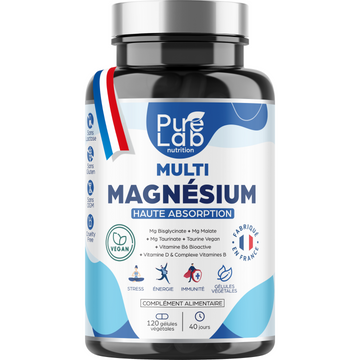
✅ Our Multi-Magnesium at Pure Lab Nutrition: 300 mg of magnesium per day from three forms (bisglycinate, taurinate, malate), combined with vitamins B6 and D.
👉 Discover our Multi-Magnesium here.
⏰ How to take them?
🧬 Question 5: what is the best time of day?
It depends on the nutrient. Fat-soluble vitamins (A, D, E, K) are better absorbed with a meal containing fats. Minerals like zinc are sometimes better tolerated with a little food. The most important thing is to choose a time that you can stick to every day: associating the intake with a daily habit (breakfast, brushing teeth) helps a lot. Always follow the dosage indicated on the label.
🧬 Question 6: can you combine several supplements?
Often yes, but methodically. Some combinations are synergistic (vitamin C and non-heme iron: vitamin C increases iron absorption, an authorized claim), while others may compete (zinc and iron or calcium at high doses, taken simultaneously). Above all, ensure you are not doubling up on the same nutrient across multiple products, which exposes you to exceeding recommended intake levels. Our guide Can you take several supplements at the same time? explains how to do it.
🛡️ Safety and precautions
🧬 Question 7: are supplements safe?
"Natural" does not mean "risk-free." Taken at recommended doses and by a person without contraindications, common nutrients are generally well tolerated. But excessive intake, drug interactions, or certain plants can be problematic. Anses manages a nutrivigilance system that collects adverse effects reported after the consumption of supplements, and EFSA sets tolerable upper intake levels for many vitamins and minerals. Do not exceed the indicated daily dose.
🧬 Question 8: who should ask for advice before starting?
Pregnant or breastfeeding women, children, people undergoing medical treatment (anticoagulants, thyroid treatments, immunosuppressants, etc.), or those suffering from a chronic condition must seek the advice of a healthcare professional. This precaution is especially relevant for plant extracts. A supplement does not replace treatment or a medical consultation.
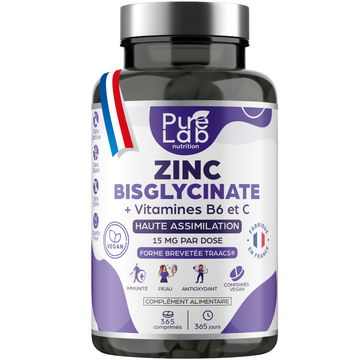
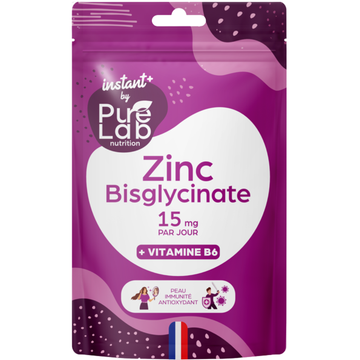
✅ Our Zinc Bisglycinate at Pure Lab Nutrition: 15 mg of zinc per tablet, a clearly stated dosage, combined with vitamins B6 and C.
👉 Discover our Zinc Bisglycinate here.
🔍 Results and quality
🧬 Question 9: how long before seeing effects?
There is no universal timeline. Some nutrients act over a period of several weeks, others require months, and the response varies from one person to another depending on diet, baseline levels, and lifestyle. A course of at least one to three months is often suggested to evaluate a supplement, but this is only indicative. To learn more, consult How long does it take to see the effects of a supplement?.
🧬 Question 10: how to recognize a quality supplement?
A few objective criteria: a readable composition with the quantities of each active ingredient, identified nutrient forms (bisglycinate, methylcobalamin, etc.), claims that comply with regulations, clear cautionary statements, and a short list of ingredients. Be wary of promises of rapid results and opaque formulas ("proprietary blends" without dosages). Our article How to read a food supplement label gives you a step-by-step method.
🧬 Summary of your best practices
Identify a need, choose a suitable form, read the label, respect the dose, start with one product only, and re-evaluate after a few weeks. This progressive approach also protects your budget.
✅ In summary
1️⃣ A food supplement complements the diet; it does not replace it and is not a drug.
2️⃣ Only claims authorized by Regulation (EU) No. 432/2012 may appear on packaging.
3️⃣ Respect the dosage, avoid nutrient overlaps, and seek advice in case of pregnancy, ongoing treatment, or medical conditions.
4️⃣ Judge a product by its transparency: dosages, forms, and a readable composition.
Pure Lab Nutrition — The art of nourishing your well-being.
Scientific sources:
- Directive 2002/46/EC of the European Parliament and of the Council of 10 June 2002 on the approximation of the laws of the Member States relating to food supplements.
- Regulation (EC) No. 1924/2006 of the European Parliament and of the Council of 20 December 2006 on nutrition and health claims made on foods.
- Commission Regulation (EU) No. 432/2012 of 16 May 2012 establishing a list of permitted health claims made on foods.
- EFSA. Tolerable Upper Intake Levels for Vitamins and Minerals. Scientific Committee on Food / EFSA Panel on Dietetic Products, Nutrition and Allergies, 2006.
- Anses. Nutrivigilance system: surveillance of adverse effects related to the consumption of food supplements (anses.fr).


Restez informé 🌿
Recevez nos derniers articles et conseils santé directement dans votre boîte mail.