
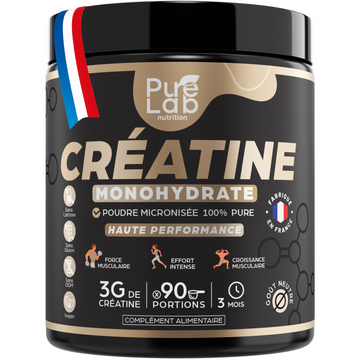



















💪 Creatine 3g or 5g: Why Studies Recommend the Minimum Effective Dosage
You may have noticed the "standard" 5g scoops in every creatine tub. But here's a scientific truth rarely mentioned: after 35 days of supplementation, both the 3g and 5g groups showed significant and equivalent strength gains (Δ% 1RM = 20.0 ± 4.0 for 3g vs 19.9 ± 1.5 for 5g), with no significant difference between the two dosages.
At Pure Lab Nutrition, we prioritize intelligent efficiency over marketing-driven overconsumption.
📑 Summary
- Why 3g is enough for optimal results
- The science behind 3g = 5g equivalence
- Loading phase: accelerating saturation
- Full protocols compared
- Caffeine-creatine interaction explained
- Timeline of results
- Non-negotiable quality criteria
-
Conclusion & recommendations
🎯 3g Is Enough For Optimal Results
A comparative study by Vilar Neto et al. (2018) involving 36 strength training practitioners directly compared 3g and 5g groups. Result: strictly equivalent strength gains (Δ% 1RM = 20.0 ± 4.0 for 3g vs 19.9 ± 1.5 for 5g), with a visible increase as early as 7 days of supplementation for both groups (compared to 14 days for placebo).
Why is 3g enough? Studies show that a significant improvement in performance is achieved with approximately 0.03g/kg of body weight. For an individual weighing 77kg, this equates to only 2.3g per day, less than half the "standard" dose of 5g. Studies on 1-2g/day dosages proved ineffective, but 3g represents the scientifically validated minimum effective dose.
💰 The Concrete Financial Impact
- With 5g/day dosage → 300g tub = 60 days (≈2 months)
- With 3g/day dosage → 300g tub = 90 days (≈3 months)
Savings: 40% less creatine for identical results. Your tub lasts 66% longer, with no loss of efficacy.
📏 The Body Weight Myth
Muscle saturation with phosphocreatine depends on active muscle mass, not total weight.
Contrary to what some claim, 3g is sufficient even for athletes over 100kg+. Why? Because muscle saturation with phosphocreatine is not proportional to total body weight, but to active muscle mass. And even bodybuilders over 100kg+ achieve complete saturation with 3g/day after 3-4 weeks. There is no benefit to exceeding this dose for maintenance.
Your muscles store approximately 120–160 mmol/kg of phosphocreatine. Once this capacity is reached, any surplus is eliminated. Both dosages reach the same plateau, with only a 1 to 2-week difference.
The 3 phases of muscle creatine:
1. Initial storage (unsupplemented): ~100-115 mmol/kg
2. Optimal saturation (with supplementation): ~140-150 mmol/kg
3. Maximum saturation (physiological ceiling): ~160 mmol/kg
The difference between 3g and 5g? You reach the same saturation plateau, just with a slight time lag (2-3 weeks vs 3-4 weeks). But after 35 days, both groups are at the same saturation level, hence the identical results observed in Vilar Neto's study.
The scientific truth:
- A 60kg athlete and a 95kg athlete both reach ~140-150 mmol/kg of muscle saturation
- The difference? The heavier person might take 1 week longer to fully saturate
- Identical final result: +20% (on average) strength in both cases
Important note: Even for athletes over 100kg, exceeding 3g daily in the maintenance phase provides no additional scientifically demonstrated benefit. Your muscles have a limited storage capacity for phosphocreatine, regardless of your body weight.
📊 The 5g Scoop Myth
The 5g standard simply comes from the size of the scoops. Early studies used 20g/day in the loading phase and then 5g, without comparison to lower doses. Today, research shows that 3g is sufficient for the same efficacy.
❓3g or 5g? We answer!
Creatine works by a mechanism of progressive saturation of muscle fibers with phosphocreatine (PCr). This process follows a biological ceiling logic: once muscle reserves are full, any surplus is simply eliminated by the kidneys via urinary creatinine.
This is precisely why the dose matters less than the duration of supplementation. With 3g/day, the saturation process is slightly slower, but the final result (the level of phosphocreatine stored in the muscle) is strictly identical to that obtained with 5g/day.
Mechanistically, creatine increases ATP availability during intense, short efforts (< 10 seconds), improves recovery between sets, and promotes intramuscular hydration... three factors directly linked to strength and mass gains. These effects do not depend on the dose beyond the saturation threshold, but only on the saturation state itself.
In other words: what matters is not how much you take, but how long you have been consistent.
⚡ The Loading Phase: Accelerating Saturation
The classic loading phase consists of taking 5g × 4 times/day for 5–7 days (i.e., 20g/day). This allows for complete saturation in 7 to 10 days.
✅ Advantages
- Rapid muscle saturation (7–10 days)
- Visible results from the 2nd week
- Muscle weight gain +1.5–3kg
⚠️ Disadvantages
- Temporary water retention
- Possible digestive discomfort
- Faster consumption of the tub
Alternative: a constant dosage of 3g/day from the start → same results in 3-4 weeks without digestive discomfort.
📊 Full Protocols Compared
| Criterion | With Load | Without Load |
|---|---|---|
| Complete saturation | 7–10 days | 21–28 days |
| Strength gain (week 5) | +25% | +25% |
| Digestive comfort | Variable | Excellent |
| Creatine consumed | 413g | 308g |
🚫 Caffeine-Creatine Interaction Explained
Studies show that consuming caffeine and creatine together can reduce the latter's effects on muscle performance. ☕Avoid taking them simultaneously. Space your intakes by at least 2 to 3 hours.
Studies show that consuming caffeine and creatine together can reduce the latter's effects on muscle performance.
The mechanism involved is well-documented: caffeine is an adenosine receptor antagonist, which leads to an increase in intracellular calcium and a modification of muscle relaxation. However, creatine acts precisely by optimizing ATP resynthesis in the same cellular environment. When the two substances are taken simultaneously, their mechanisms of action compete at the muscle level, reducing the net effectiveness of creatine.
A study by Trexler et al. (2015) showed that co-ingestion of caffeine and creatine partially negated the performance benefits obtained with creatine alone, particularly for explosive strength exercises.
The practical rule: avoid taking them simultaneously. Space your intakes by at least 2 to 3 hours. If you drink your coffee in the morning, shift your creatine dose to mid-morning or lunch.
- Week 1–2: slight weight gain (intramuscular water)
- Week 3–4: +15–20% strength
- Week 5–8: stable plateau and visible muscle gains
-
12 weeks: complete saturation and lasting benefits
✅ Non-Negotiable Quality Criteria
1️⃣ Scientifically Validated Form
Only choose creatine monohydrate. HCL, ethyl ester, or buffered forms offer no demonstrated benefits.
2️⃣ Purity ≥ 99.9%
Prefer French brands: this guarantees optimal traceability and safety. The product packaging must state a purity of at least 99%. Insufficient purity can lead to the presence of contaminants like creatinine, dicyandiamide, or dihydrotriazine... undesirable manufacturing by-products.
3️⃣ Micronization & Dissolution
Micronized powder (200 mesh) dissolves perfectly and reduces digestive discomfort.
4️⃣ Total Transparency
Check the origin, certification, and absence of unnecessary additives. A reputable brand clearly communicates purity analyses (upon customer request).
🎯 Conclusion & Final Recommendations
The International Society of Sports Nutrition confirms that creatine monohydrate is the most effective supplement for performance, strength, and muscle recovery.
The optimal dosage remains 3g per day after initial saturation.
- 💧 Hydrate (2–3L/day)
- ☕ Limit caffeine
- 📆 Be consistent (same time every day)
Studies are unanimous: there's no need to consume more. Efficacy relies on consistency, not quantity.
Pure Lab Nutrition... The art of nourishing your well-being.
📚 Scientific Sources
- Vilar Neto, J.D.O., et al. (2018). Effects of Low-Dose Creatine Monohydrate on Muscle Strength and Endurance. Asian Journal of Sports Medicine, 9(3):e62739.
- Trexler, E.T., et al. (2015). Effects of Coffee and Caffeine Anhydrous Intake During Creatine Loading. J Strength Cond Res, 30(5):1438–46.
- Kreider, R.B., et al. (2017). ISSN Position Stand: Safety and Efficacy of Creatine Supplementation. J Int Soc Sports Nutr, 14:18.
- Antonio, J., et al. (2021). Common Questions and Misconceptions About Creatine Supplementation. J Int Soc Sports Nutr, 18:13.


Restez informé 🌿
Recevez nos derniers articles et conseils santé directement dans votre boîte mail.


