



























Should you take a multivitamin? The guide to choosing the right one
Multivitamins are among the best-selling supplements in the world. For some, they are a nutritional "insurance policy"; for others, a waste of money. As is often the case, the truth lies somewhere in between.
At Pure Lab Nutrition, we prefer to give you the keys to decide for yourself. Here is what science says, who might benefit from a multivitamin, how to choose a high-quality formula, how to take it, and which mistakes to avoid.
📑 Contents
- What is a multivitamin?
- What science says
- Who can it be useful for?
- Why nutritional deficiencies are on the rise
- Criteria for a good formula
- How to take it daily
- Common mistakes
- Frequently Asked Questions
- In summary
What is a multivitamin?
A multivitamin combines several vitamins and minerals into a single formula, sometimes accompanied by other nutrients. The idea: to cover a portion of your micronutrient needs in one dose, as a complement to your diet.
The real question is not whether your diet provides micronutrients—it does. It is whether it provides enough, and on a regular basis. And on this point, the context has changed: our needs haven't shifted, but the nutritional density of fresh produce has declined over the past fifty years, a growing share of our everyday diet is ultra-processed, and meals are increasingly eaten on the go.
This is exactly the gap that a well-formulated multivitamin fills: truly absorbable forms, dosages consistent with nutritional references, and no unnecessary excess.
What science says
🔬 Not a shield against disease
In 2022, the US Preventive Services Task Force, the leading American authority on prevention, concluded that there was insufficient evidence to recommend multivitamins for the purpose of preventing cardiovascular disease or cancer in healthy adults. It further advises against beta-carotene and vitamin E supplements for this purpose.
✅ But a real role in meeting needs
This recommendation does not apply to people with a deficiency or specific needs. Vitamins and minerals retain their essential roles, as recognized at the European level: for example, vitamin C, zinc, and vitamin D contribute to the normal function of the immune system, and vitamins B6, B12, and C contribute to the reduction of tiredness and fatigue.
In summary: the role of a multivitamin is nutritional, not medicinal—and that is precisely what is expected of it. Its place is clear: to secure intakes that, in real life, are more often borderline than we realize, using forms the body can actually use. Viewed this way, it is a rational response to a changed dietary landscape.
Who can it be useful for?
- People with a less varied diet: meals on the go, few fruits and vegetables, restrictive diet
- People with low appetites, particularly certain seniors
- Athletes with increased needs
- During busy periods, fatigue, or seasonal changes
- Vegetarians, as a complement to medical monitoring of their status
For a woman who is pregnant or wishing to become so, specific formulas exist: talk to your doctor or midwife.
👥 Three profiles, three responses
✅ Julie, 29, busy executive: quick lunches, few vegetables during the week. A multivitamin can help her during busy periods, provided she also works on improving her meals.
✅ Marc, 45, very varied diet: he eats everything, plenty of fruits and vegetables. His margin is better, but it depends on what these foods actually contain: a multivitamin without iron or copper, with reasonable dosages, serves as a safety net for the nutrients most often in short supply.
✅ Monique, 72, small appetite: she eats less than before. A multivitamin may make sense, ideally after discussing it with her doctor.
Why nutritional deficiencies are on the rise
Contrary to popular belief, micronutrient deficiencies do not just affect developing countries. Several structural factors explain why a significant proportion of the population in industrialized countries does not meet its needs for certain micronutrients:
- The decline in nutritional density of crops: in comparing USDA composition data for 43 garden crops between 1950 and 1999, Davis and colleagues found statistically reliable decreases for six nutrients—protein, calcium, phosphorus, iron, riboflavin, and vitamin C—with medians ranging from −6% for protein to −38% for riboflavin. The authors attribute this primarily to the selection of high-yield varieties, which involves a trade-off between yield and nutrient content; added to this are soil depletion and delays in harvesting, transport, and storage. At the scale of a single food-nutrient pair, the differences are not always distinguishable: it is the overall trend that is solid.
- Ultra-processed foods: industrial processes (intense heat, refining, addition of additives) destroy part of the water-soluble vitamins—particularly B vitamins—and modify the bioavailability of certain minerals.
- Chronic stress: it increases the body's consumption of magnesium, zinc, and B vitamins, a phenomenon documented in physiological literature. People subject to prolonged professional or personal stress may have higher needs than reference values.
- Fragmented eating patterns: skipped meals, industrial snacks, lunches on the go—the reality for working adults is moving further away from the theoretical model used to calculate nutritional references.
In other words, supplementing is neither a luxury nor an admission of dietary failure: it is a rational response to a context that has changed. The formula must still be up to the task—bioavailable forms, consistent dosages, no fillers.
Criteria for a good formula
| Criterion | What to look for |
|---|---|
| Dosages | Close to daily needs, without unnecessary excess |
| Forms | Well-absorbed forms: bisglycinates for minerals, vitamin D3, active folates, vitamin K2 |
| Iron | Useful only in case of proven need; an iron-free formula is suitable for most men and postmenopausal women |
| Additives | As few as possible: no unnecessary dyes |
| Transparency | Each nutrient and its quantity clearly indicated |
🔎 Why the form of minerals matters
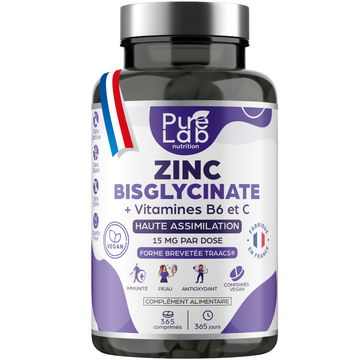
Take zinc, for example. A review published in 2024 in Nutrients (Devarshi et al.) compared the absorption of its various forms in humans: the authors conclude that zinc glycinate and zinc gluconate appear to be better absorbed than other forms. However, they advise interpreting these results with caution, given the small number of studies per form. Also of note: the authors work for a supplement manufacturer that funded this work.
The same principle applies to magnesium (the bisglycinate form is better tolerated than oxide), to folates (the active form, 5-MTHF, is used directly without a conversion step), and to vitamin K (the K2 MK-7 form is retained better in the body than K1).
🏷️ What the label should tell you
The DGCCRF (French consumer protection agency) reiterates that the label of a food supplement must include mandatory information, including the recommended daily portion, a warning against exceeding this dose, and standard regulatory mentions required for all food supplements. Regulations also recommend caution when combining several supplements, and seeking the advice of a healthcare professional for pregnant or breastfeeding women, children, adolescents, and people under medical treatment. To decode a label step-by-step, read How to read a food supplement label.
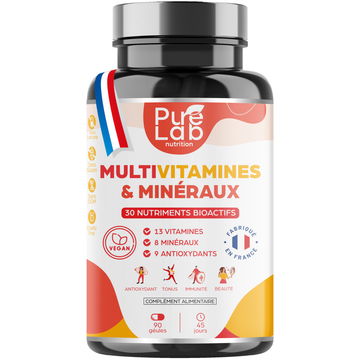
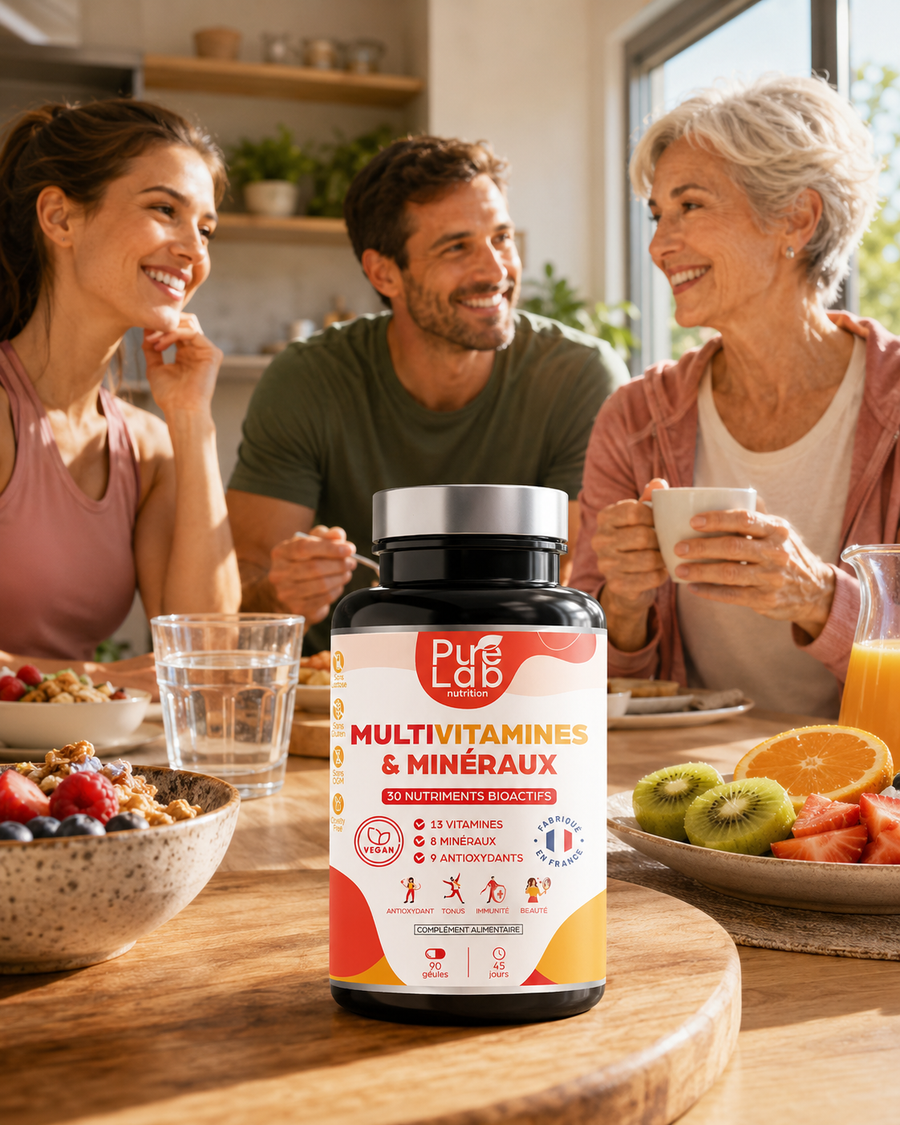
🌟 Our Multivitamin & Minerals
✅ Selected forms: vitamin D3, vitamin K2 (K2VITAL®), active folates (Quatrefolic®), minerals in bisglycinate form
✅ Iron-free and copper-free, for a formula suitable for both men and women
✅ 2 capsules per day
👉 Discover our Multivitamin & Minerals here.
How to take it daily
During a meal is generally the simplest and most logical approach. Some vitamins are fat-soluble, meaning they dissolve in fats: this is the case for vitamin D. A 2015 study (Dawson-Hughes et al.) conducted on 50 older adults observed that the peak of vitamin D3 in the blood was on average 32% higher when the supplement was taken with a meal containing fat rather than one without.
Regularly: a multivitamin is for the long term, not a one-off. Pair it with a fixed meal, such as breakfast or lunch. For full details, read our article Multivitamins: when and how to take them?
Common mistakes
- Combining several supplements without checking: a multivitamin plus zinc plus vitamin D... the amounts add up. Our article Can you take several supplements at the same time? helps you clear things up
- Taking it on an empty stomach with just a glass of water: you miss out on the beneficial effect of a meal on fat-soluble vitamins
- Choosing a formula with iron "by default": iron is only useful if needed, ideally confirmed by testing
- Ignoring the quality of the forms used: a cheap multivitamin with zinc oxide or inactive folates will have lower bioavailability
- Not mentioning it to your doctor, especially if you are undergoing treatment
Frequently Asked Questions
❓ Should you take a multivitamin all year round?
It depends on your diet and lifestyle. Some people take it continuously, others during periods when their diet is less balanced. The main thing is to regularly assess your needs.
❓ Why a formula without iron?
Because the need for iron varies greatly from one person to another. An iron-free formula is suitable for most men and postmenopausal women. If you are deficient in iron, it is better to verify this with your doctor and adjust intake accordingly.
❓ Why don't fruits and vegetables solve everything?
Because the question is not the quantity of food, but what it contains. Work by Davis et al. shows, based on fifty years of USDA data, that the content of several nutrients in garden crops has declined due to the selection of high-yield varieties. Add to this transport and storage times, ultra-processing, and irregular meal schedules: intakes are more often borderline than we think, including in people who are careful. A well-dosed, well-formulated multivitamin is the most reliable lever for regularly meeting nutritional references. We actually dedicated an article to this question: Do fruits still really contain vitamin C?
❓ Does a multivitamin give you immediate energy?
It is not a stimulant: its effect is not felt hour by hour, but week by week. Vitamins B6, B12, and C contribute to the reduction of fatigue, and it is the regularity of intake that allows these benefits to take hold. Count on a few weeks of continuous use to judge.
❓ What is the difference between folates and folic acid?
Folic acid is a synthetic form that must be converted by the body before it can be used. Active folates (5-MTHF, like Quatrefolic®) can be used directly, even by people with a variant of the MTHFR gene that impairs this conversion. Preferring active folates in a multivitamin is therefore relevant for better bioavailability.
❓ Can you give a multivitamin to a child?
Children's needs are different from those of adults, and adult formulas are not suitable for them. Consult your pediatrician or family doctor before giving any supplement to a child or adolescent.
In summary
1️⃣ A nutritional role, not a medicinal one: that is exactly what we expect from it
2️⃣ A response to a changed context: our needs remain the same, but the nutritional density on our plate has decreased
3️⃣ Reasonable dosages and well-absorbed forms: the key criteria
4️⃣ During a meal, regularly: consistency is more important than timing
5️⃣ Check the forms: bisglycinates, D3, K2, and active folates make the difference
Pure Lab Nutrition ... The art of nourishing your well-being.
Sources:
- US Preventive Services Task Force (2022). Vitamin, Mineral, and Multivitamin Supplementation to Prevent Cardiovascular Disease and Cancer: Final Recommendation Statement. uspreventiveservicestaskforce.org
- American Family Physician (2022). Vitamin, Mineral, and Multivitamin Supplementation to Prevent Cardiovascular Disease and Cancer, 106(5). aafp.org
- Devarshi P.P., Mao Q., Grant R.W., Hazels Mitmesser S. (2024). Comparative Absorption and Bioavailability of Various Chemical Forms of Zinc in Humans: A Narrative Review. Nutrients, 16(24), 4269. PMC
- Dawson-Hughes B., Harris S.S., Lichtenstein A.H., et al. (2015). Dietary fat increases vitamin D-3 absorption. Journal of the Academy of Nutrition and Dietetics, 115(2), 225-230. PubMed
- DGCCRF. Étiquetage, présentation et publicité des compléments alimentaires : les règles à connaître. economie.gouv.fr
- Davis DR, Epp MD, Riordan HD (2004). Changes in USDA Food Composition Data for 43 Garden Crops, 1950 to 1999. J Am Coll Nutr, 23(6):669-682. DOI
- Règlement (UE) n° 432/2012 établissant une liste des allégations de santé autorisées. EUR-Lex


Restez informé 🌿
Recevez nos derniers articles et conseils santé directement dans votre boîte mail.


