





















How to read a dietary supplement label (2nd edition: the new 2026 rules)
Product name, daily portion, NRV percentages, allergens: a food supplement label packs a lot of information into a very small space. This second edition of our guide revisits the current rules and gives you a simple method to read every line with confidence.
📑 Summary
- An evolving regulatory framework: what you need to know
- Mandatory information, line by line
- Daily portion, NRVs, and doses: understanding the numbers
- List of ingredients, forms, and additives
- Claims and promises: what the label can state
- Our five-step reading method
🔬 An evolving regulatory framework: what you need to know
The title of this article mentions "new 2026 rules." Let's be precise: the regulations applicable to food supplement labeling are based on stable texts, which European and national authorities supplement regularly. The pillars are Regulation (EU) No 1169/2011, known as the FIC Regulation, regarding the provision of food information to consumers, Directive 2002/46/EC on food supplements, and, in France, Decree No 2006-352 of March 20, 2006.
Rather than promising changes that we cannot document, we provide here the rules in force and lasting reading reflexes. To track any potential developments, the DGCCRF and Légifrance websites remain the references to consult.
🧬 Three texts to know
The FIC Regulation sets out mandatory information for all prepackaged foods. Directive 2002/46/EC adds specific requirements for supplements. The 2006 decree transposes them into French law and clarifies certain requirements. Together, they form the foundation of what you should find on a package. For a first level of reading, you can also consult our article How to read a food supplement label.
🏷️ Mandatory information, line by line
Article 9 of the FIC Regulation lists the mandatory information. For a food supplement, you should find in particular: the sales name, accompanied by the term "food supplement"; the list of ingredients; allergens highlighted in that list; net quantity; the date of minimum durability ("best before..."); special storage and usage conditions; the name or business name and address of the responsible operator; and a batch number for traceability.
Directive 2002/46/EC (Article 6) adds provisions specific to supplements: the names of the categories of nutrients or substances that characterize the product, the recommended daily portion, the warning not to exceed the indicated dose, the clarification that supplements should not be used as substitutes for a varied diet, and the warning to keep the product out of the reach of young children.
🔎 Legibility and language
Mandatory information must be easily visible, clearly legible, and indelible. The FIC Regulation generally requires a minimum x-height of 1.2 mm for characters (Article 13), with an exception for very small packaging. Furthermore, information must be provided in a language easily understood by consumers in the country of sale, which means French in France.
As for origin, its indication is only mandatory in specific cases provided for in Article 26 of the regulation, particularly when its omission would be likely to mislead the consumer. Its presence or absence is therefore not, in itself, an indicator of quality.
📏 Daily portion, NRVs, and doses: understanding the numbers
The composition table indicates the amount of each nutrient per daily portion. For vitamins and minerals, the quantity must also be expressed as a percentage of the Nutrient Reference Values (NRVs) established in Annex XIII of the FIC Regulation. For example, these values are 80 mg for vitamin C, 10 mg for zinc, and 375 mg for magnesium.
Caution: an NRV percentage above 100% is not necessarily a problem, nor a guarantee of quality. NRVs serve as labeling references for an average adult; they are not individual recommendations. What matters is the dose relative to your dietary intake and the safety limits established by scientific authorities. EFSA has proposed tolerable upper intake levels, for example, 25 mg per day for zinc in adults, from all sources combined.
⚖️ Per portion, not per 100 g
Always compare products based on the actually recommended daily portion, not per capsule or per gram. A bottle of 60 capsules at two capsules per day represents thirty days, while another at four capsules per day represents fifteen: price and dose should be compared on a common basis. Also, pay attention to the unit: milligrams, micrograms (µg), or international units are not interchangeable without conversion.
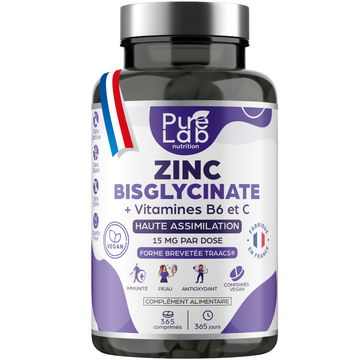
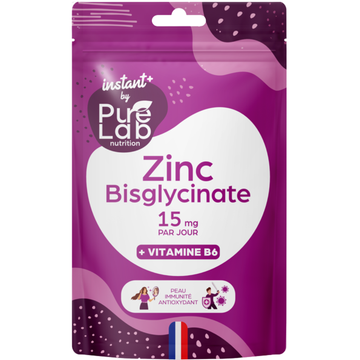
✅ Our Zinc Bisglycinate at Pure Lab Nutrition: a legible label with the nutrient form clearly indicated and the intake reported against NRVs, so you can compare with full transparency.
👉 Discover our Zinc Bisglycinate here.
🧪 List of ingredients, forms, and additives
The list of ingredients is ordered by weight at the time of manufacture. For a supplement, it includes the sources of the nutrients (e.g., the mineral's chemical form) but also bulking agents, anti-caking agents, any colorings, and the capsule shell. This list often reveals more than the brand name.
Locate the nutrient's form: it is distinct from the quantity of pure element. A label stating "200 mg of zinc bisglycinate" does not mean 200 mg of zinc: only a portion of the mass corresponds to the element. Reliable labels indicate the amount of the element provided (e.g., elemental zinc) and not just that of the salt. We detail the impact of forms in our article on choosing between zinc bisglycinate, gluconate, and citrate.
🌱 Allergens and special diets
The allergens listed in Annex II of the FIC Regulation (gluten, crustaceans, fish, milk, soy, nuts, etc.) must appear clearly in the list, for example in bold. This is particularly important for marine-derived products or supplements containing food-derived excipients. Terms like "vegan" or "gluten-free" are voluntary claims, which must remain accurate.
📣 Claims and promises: what the label can state
Health claims are governed by Regulation (EC) No 1924/2006: only authorized claims included in the European register are permitted, using wording similar to that in Regulation (EU) No 432/2012. You will read, for example, that a vitamin or mineral "contributes" to normal functioning: to the maintenance of normal skin for zinc, or to the reduction of fatigue for magnesium. The verb "contributes" is not trivial: it indicates a role in normal physiological functioning, never an action on a disease.
Beware of promises that go beyond this framework: spectacular numerical results, references to pathologies, or testimonials presented as proof. The mention of a claim also assumes that the product meets usage conditions, including a minimum threshold of the nutrient per portion. To delve deeper, consult our food supplement glossary.
⏱️ Realistic expectations
Even an authorized claim does not guarantee individual results or a specific timeframe. To know what to expect, read our article How long does it take to see the effects of a supplement?
🧭 Our five-step reading method
First step: check the term "food supplement" and the identity of the operator, including their address. Second step: locate the daily portion and the number of portions per box. Third step: read the composition table and the NRV percentages, distinguishing the pure element from its form. Fourth step: browse the list of ingredients and allergens, then the excipients. Fifth step: examine claims and warnings, especially precautions for pregnant women, children, or people on medication.
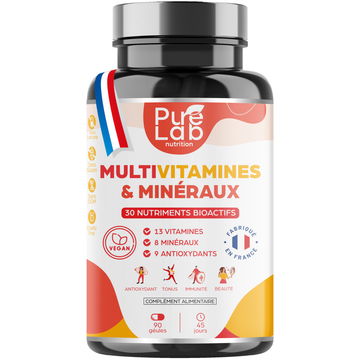
If a point remains unclear, the right question to ask the manufacturer or your pharmacist is simple: "What amount of pure element per portion, in what form, and what are the usage precautions?" A transparent operator answers directly. If taking medication, pregnant, or suffering from a condition, always seek the advice of a healthcare professional before starting a course. See also our guide Should you take a multivitamin?
✅ In summary
1️⃣ Labeling is based on the FIC (EU) Regulation No 1169/2011, Directive 2002/46/EC, and Decree No 2006-352: check Légifrance and the DGCCRF for updates.
2️⃣ Check the daily portion, the warning not to exceed it, and the term "food supplement."
3️⃣ Compare doses per portion, as a percentage of NRV, and distinguish the pure element from its form.
4️⃣ Claims must remain measured ("contributes to"); in case of doubt or if taking medication, seek advice from a healthcare professional.
Pure Lab Nutrition — The art of nourishing your well-being.
Scientific sources:
- Regulation (EU) No 1169/2011 of the European Parliament and of the Council of 25 October 2011 on the provision of food information to consumers (Articles 9, 13, 26; Annexes II and XIII).
- Directive 2002/46/EC of 10 June 2002 on food supplements, Article 6.
- Decree No 2006-352 of 20 March 2006 on food supplements – Légifrance.
- Regulation (EC) No 1924/2006 on nutrition and health claims made on foods, and Regulation (EU) No 432/2012 establishing the list of permitted health claims.
- EFSA, "Tolerable Upper Intake Levels for Vitamins and Minerals", 2006; DGCCRF, "Food supplements" fact sheet.


Restez informé 🌿
Recevez nos derniers articles et conseils santé directement dans votre boîte mail.