





















Vitamin B12 and pregnancy: requirements, dosage and precautions
During pregnancy, every nutrient counts, and vitamin B12 is no exception. However, between actual needs, doses found in supplements, and at-risk situations, it is easy to get lost. Here is a factual overview, supported by European standards and scientific literature, with a simple rule: any supplementation during pregnancy should be discussed with a healthcare professional.
📑 Contents
- The role of vitamin B12
- Needs during pregnancy
- Who is at risk of insufficient intake?
- What research says
- Dosage, forms, and precautions
- B12, folates, iron: an overview
🔬 The role of vitamin B12
Vitamin B12, or cobalamin, is a water-soluble vitamin that the body cannot produce. It comes almost exclusively from animal-based foods: meat, fish, eggs, and dairy products. Plants do not contain it in any reliable way.
🧬 What it does in the body
Vitamin B12 contributes to the normal formation of red blood cells, normal cell division, normal functioning of the nervous system, normal homocysteine metabolism, normal energy metabolism, and normal psychological function. It also contributes to the normal functioning of the immune system and the reduction of tiredness and fatigue. These claims are authorized by Regulation (EU) No 432/2012.
It works in tandem with folates (vitamin B9): both are involved in homocysteine metabolism and cell division, two processes that are particularly active when tissues are developing rapidly, such as during pregnancy.
🔬 Needs during pregnancy
In 2015, the European Food Safety Authority (EFSA) set an adequate intake of 4 µg per day for adults. This reference increases to 4.5 µg per day during pregnancy and 5 µg per day during breastfeeding. The gap is moderate; it reflects the needs related to fetal growth and the reserves passed to the newborn through breast milk.
🍽️ How much is that in food?
These amounts are low and can be reached with a diet that includes animal-based products. Some orders of magnitude: organ meats like liver are very rich in B12, but they are not recommended during pregnancy for other reasons (vitamin A content). Fish, well-cooked seafood, eggs, dairy products, and meat also contribute. Lists of foods to avoid during pregnancy are established by health authorities, and your midwife or doctor will be able to explain them to you.
🔍 A reserve of several years, but not for everyone
The liver stores B12 in significant quantities, which explains why a deficiency sometimes takes years to appear in an adult whose diet has become low in B12. Conversely, this reserve may be low in a woman whose intake has been low for a prolonged period, even before conception.
🔬 Who is at risk of insufficient intake?
Several profiles deserve special attention.
🌱 Vegetarian and vegan diets
This is the most clearly documented factor. A literature review (Pawlak et al., 2013) indicates that vegetarians and especially vegans have a notable risk of insufficient B12 status if they do not supplement. During pregnancy, a vegan diet requires specific medical monitoring. Our articles Vegetarians and vegans: why vitamin B12 is essential and Vegan or vegetarian: supplements to consider detail this point.
💊 Absorption disorders and medications
B12 absorption depends on gastric acidity and a protein called intrinsic factor. Certain digestive pathologies, bariatric surgery, or the prolonged use of certain medications (for example, metformin or proton pump inhibitors) can reduce this absorption. In these situations, the decision lies with the doctor.
📝 Signs to watch out for
Unusual fatigue, pale skin, tingling, or shortness of breath are not specific, as pregnancy itself causes many of these symptoms. Only a blood test can determine if B12 is the cause. See also Vitamin B12 deficiency: symptoms, causes, and those affected.
🔬 What research says
The scientific literature has taken a great interest in B12 status during pregnancy. Finkelstein et al. (2015) reviewed the links between maternal B12 status and perinatal health: observational data associate low status with certain risks, but they remain heterogeneous and do not, on their own, prove a cause-and-effect relationship.
📊 A status often lower than one might think
A meta-analysis (Sukumar et al., 2016) estimated the frequency of insufficient B12 status during pregnancy in different populations. Prevalence varies greatly from one country to another, with higher figures in populations with meat-poor diets. An Irish study (Molloy et al., 2009) also observed a link between low maternal B12 status and a higher risk of neural tube defects in a population not exposed to folic acid fortification. This is an observational association, which underscores the importance of correctly meeting needs, without justifying any promises.
⚠️ The limits
Today, one cannot turn these observations into a general individual recommendation for all pregnant women. This is why healthcare professionals reason on a case-by-case basis: dietary profile, blood tests, and medical history.
🔬 Dosage, forms, and precautions
The EFSA has not set an upper safe limit for vitamin B12 because no adverse effects have been clearly established at high intakes in healthy adults. This does not mean that any dose is suitable for all situations, particularly during pregnancy, a period for which data on high doses are lacking.
💊 Forms of B12
Supplements contain cyanocobalamin, methylcobalamin, hydroxocobalamin, and adenosylcobalamin. Each has its own particularities, which we detail in Methylcobalamin or cyanocobalamin: which form of B12 to choose?.
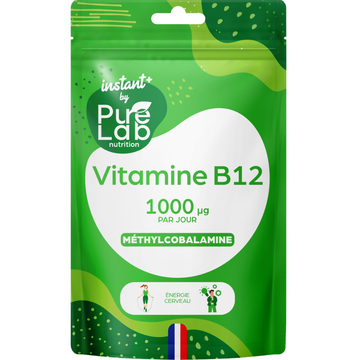
✅ Our Vitamin B12 (Instant+) at Pure Lab Nutrition: 1000 µg of methylcobalamin in capsules, in pocket format.
👉 Discover our Vitamin B12 (Instant+) here.
🚫 Our precautions
This formula is dosed at 1000 µg, which is well above the 4.5 µg reference. It is primarily intended for healthy adults wishing to supplement their intake. For pregnant or breastfeeding women, do not take any supplement, including this one, without the prior advice of your doctor, midwife, or pharmacist. Dietary supplements are not a substitute for a varied and balanced diet and should not exceed the recommended daily dose.
🔬 B12, folates, iron: an overview
Pregnancy requires several nutrients at the same time, and it would be reductionist to reason about just one.
🌿 Folic acid and folates
Health authorities recommend that women planning a pregnancy seek advice from a healthcare professional regarding folic acid (vitamin B9) supplementation, generally before conception and during the first few weeks. Folates contribute to the growth of maternal tissues during pregnancy. The doctor will specify the dose and duration, which may vary depending on medical history.
🩸 Iron
Iron needs increase significantly during pregnancy because blood volume increases. Iron contributes to the normal formation of red blood cells and hemoglobin, as well as normal oxygen transport. Supplementation, particularly with a bisglycinate form, is subject to a prescription or medical advice based on a ferritin blood test: no excess or automatic usage.
📞 When to consult?
From the time you plan a pregnancy, or in the case of a vegan diet, digestive pathology, long-term treatment, or unexplained fatigue. Your healthcare professional may request a B12 test and, if necessary, a methylmalonic acid or homocysteine test to refine the evaluation.
✅ In summary
1️⃣ The European reference is 4 µg/day for adults and 4.5 µg/day during pregnancy: modest amounts, provided by animal-based products.
2️⃣ The risk of insufficient intake mainly concerns vegetarian and vegan diets, as well as absorption disorders.
3️⃣ Observational data should be taken seriously, but they do not replace an individual assessment.
4️⃣ During pregnancy, no supplements without medical advice: B12, folates, and iron should be decided upon together, with biological monitoring.
Pure Lab Nutrition — The art of nourishing your well-being.
Scientific sources:
- EFSA NDA Panel. Scientific Opinion on Dietary Reference Values for cobalamin (vitamin B12). EFSA Journal, 2015;13(7):4150.
- Finkelstein JL, et al. Vitamin B12 and perinatal health. Advances in Nutrition, 2015;6(5):552-563.
- Sukumar N, et al. Prevalence of vitamin B-12 insufficiency during pregnancy and its effect on offspring birth weight: a systematic review and meta-analysis. American Journal of Clinical Nutrition, 2016;103(5):1232-1251.
- Molloy AM, et al. Maternal vitamin B12 status and risk of neural tube defects in a population with high neural tube defect prevalence and no folic acid fortification. Pediatrics, 2009;123(3):917-923.
- Pawlak R, et al. How prevalent is vitamin B12 deficiency among vegetarians? Nutrition Reviews, 2013;71(2):110-117.


Restez informé 🌿
Recevez nos derniers articles et conseils santé directement dans votre boîte mail.