




















Vegetarians and vegans: why vitamin B12 is essential
Have you chosen a vegetarian or vegan diet? Well done; it’s a choice that can be very balanced. On one condition: don't forget vitamin B12, which a plant-based diet does not provide reliably.
At Pure Lab Nutrition, we want your dietary choice to remain a healthy one. Here is why B12 is essential, what health authorities have to say about it, how to supplement correctly on a daily basis, and which other nutrients deserve your attention.
📑 Table of Contents
- Why B12 is a problem without animal products
- What health authorities say
- Vegetarian or vegan: different needs
- How to supplement
- How to choose your B12 supplement
- Building a sustainable approach
- Practical cases
- Common mistakes
- Other nutrients to monitor
- Frequently asked questions
- In summary
Why B12 is a problem without animal products
Vitamin B12 is produced by bacteria, not by plants or the animals themselves. Animals accumulate it in their tissues, which is why it is found in meat, fish, eggs, and dairy products.
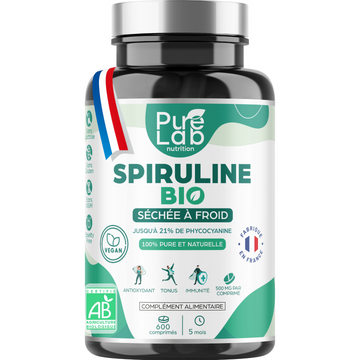
Plants do not contain significant amounts of it. The review by Temova Rakuša et al. (2022) summarizes it as follows: plant-based foods generally do not contain significant amounts of B12, with a few exceptions (certain dried seaweeds such as nori), and both vegetarians and vegans are therefore particularly at risk of deficiency. As for blue-green algae, like spirulina, they mainly contain "pseudo-vitamin B12," which is inactive in humans. You therefore cannot rely on them to meet your needs.
🏦 Reserves that mask the problem
An adult's body contains about 2 to 3 mg of B12, half of which is in the liver, and it recycles a large portion via bile: this is why a deficiency develops so slowly. It is a trap for those switching to a vegan diet: you may feel fine for years while your reserves are dwindling.
What health authorities say
🇫🇷 ANSES (2025)
In March 2025, ANSES published two expert reports dedicated to vegetarian diets, including specific dietary guidelines for vegetarian and vegan adults. Here is exactly what it says about B12:
- Regarding status: epidemiological studies show that vegetarians have a less favorable nutritional status for iron, iodine, and vitamins B12 and D than non-vegetarians.
- Regarding the plate: its work on menu optimization shows, for vegans, the difficulty of meeting nutritional requirements for vitamin B12 (as well as zinc for men).
- Regarding next steps: the agency indicates that these results will inform ongoing European work on management measures regarding food supplements and food fortification.
Note: the ANSES page acknowledges this difficulty but does not, as such, issue a recommendation for supplementation. Other authorities, listed below, go that far.
🇬🇧 The British NHS
The UK public health service is more direct: it indicates that people who have difficulty getting enough B12 through their diet, such as those following a vegan diet, may need B12 tablets for life. It also reminds us that the body's reserves can last for 2 to 5 years, which explains why a deficiency might appear long after a change in diet.
🇩🇪 German-speaking scientific societies
The German Nutrition Society (DGE), along with its Austrian and Swiss counterparts, echoes this: it considers B12 the most critical nutrient in a vegan diet and believes that vegans must take a vitamin B12 preparation permanently.
The message is therefore consistent: ANSES observes that a vegan diet struggles to meet B12 requirements, and the NHS and DGE draw the practical conclusion. For a vegan, the question is no longer whether a reliable source of B12 is needed, but how to take it regularly.
Vegetarian or vegan: different needs
| Vegetarian | Vegan | |
|---|---|---|
| B12 sources | Eggs, dairy products | No reliable natural source |
| Risk of deficiency | Possible if eating few eggs and dairy | High without a supplement |
| Our advice | Monitor your status, supplement if necessary | Supplement systematically |
Beware of the "nearly vegan" vegetarian: if you consume very few eggs and dairy products, your situation is similar to that of a vegan.
How to supplement
- Don't wait for symptoms: the body has reserves, and a deficiency can take years to manifest, sometimes with neurological effects
- Regularly: incorporate your B12 into a fixed ritual
- With monitoring: a blood test from time to time allows you to verify that everything is fine
- Fortified foods (some plant-based drinks, cereals) can supplement, but their content is variable
Vitamin B12 contributes to reducing fatigue, to the normal functioning of the nervous system, and to the normal formation of red blood cells.
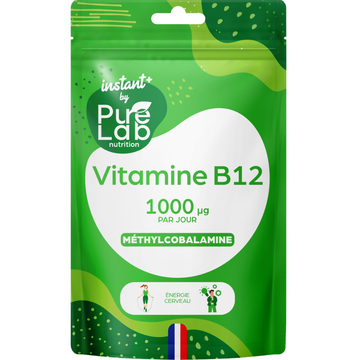
🧠 Our Vitamine B12 Instant+
✅ 1,000 µg of vitamin B12 per capsule, in methylcobalamin form
✅ Vegetable capsules, lactose-free and gluten-free
✅ Pocket size, 30-day course
👉 Discover our Vitamine B12 Instant+ here.
To understand the different forms of B12, read Methylcobalamin or cyanocobalamin: which form to choose?
How to choose your B12 supplement
| Criteria | What to look for |
|---|---|
| The form | The exact name on the label: methylcobalamin, cyanocobalamin… Both are effective; methylcobalamin is an active form, more sensitive to light |
| The amount | Expressed in micrograms (µg) per dose; supplements often exceed the 4 µg daily requirement set by EFSA because active absorption saturates quickly |
| The shell | A vegetable capsule, not animal gelatin, to remain consistent with a vegan diet |
| Storage | Away from light and moisture; methylcobalamin is light-sensitive |
Building a sustainable approach
B12 supplementation is not a one-time chore; it is a structural commitment for vegans. Here is how to incorporate it sustainably:
- Choose a fixed time: breakfast, during your first coffee or tea, or at the same time as your other supplements. Consistency matters more than the exact timing.
- Link taking it to an existing habit: keeping the box next to the kettle or coffee maker avoids forgetting.
- Store the supplement properly: away from light, in a closed cupboard. Methylcobalamin degrades in light, which can reduce its effectiveness.
- Have an annual check-up: a simple blood B12 test during your regular check-up allows you to verify that your status is satisfactory and adjust if necessary.
- Remain vigilant if changing medication: some drugs (proton pump inhibitors, metformin) can interact with B12 absorption, even in omnivores.
Practical cases
🌿 Léa, vegan for five years
Léa has never taken B12 and feels fine. This is precisely the situation that the DGE and NHS warn against: the absence of symptoms does not mean reserves are full. She talks to her doctor, who prescribes a check-up, and then she adopts a daily B12 capsule at breakfast.
🧀 Thomas, vegetarian
Thomas eats eggs and dairy products every day. His risk is lower; he simply has his status checked during his usual health check-up.
🤰 Special situations
Pregnancy, breastfeeding, vegan children, ongoing medical treatment: in these cases, supplementation must be supervised by a healthcare professional. Do not choose the dose yourself.
Common mistakes
- Believing spirulina is enough: it mainly provides a pseudo-B12, which is inactive in humans
- Relying solely on fortified foods without checking their content or consistency
- Stopping B12 when you feel fine: for a vegan, supplementation is long-term
- Never getting a check-up: regular monitoring allows you to verify that the strategy is working
- Choosing a non-vegetable capsule without checking the shell: some supplements contain animal gelatin
Other nutrients to monitor
The ANSES report points out other nutrients to monitor. Studies show that vegetarians have a less favorable status for iron, iodine, and vitamin D, as well as a less favorable calcium-phosphorus balance, and that vegans have a less favorable status for vitamin B2. Its work on menus also highlights the difficulty in meeting needs for certain long-chain omega-3s (EPA, DHA) and vitamin D for all vegetarians, and for zinc in vegan men.
| Nutrient | Profile concerned | Status according to ANSES |
|---|---|---|
| Vitamin B12 | Vegetarians and vegans | Less favorable; difficulty confirmed for vegans |
| Iron | Vegetarians | Less favorable |
| Iodine | Vegetarians | Less favorable |
| Vitamin D | All vegetarians | Difficulty meeting requirements |
| Zinc | Vegan men | Difficulty meeting requirements |
| Omega-3 (EPA/DHA) | All vegetarians | Difficulty meeting requirements |
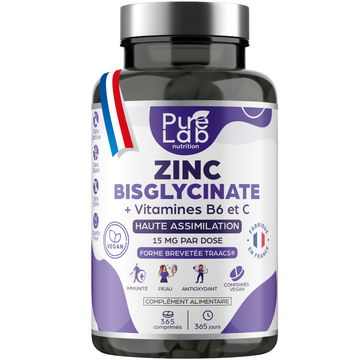
For zinc, read our article Zinc: roles, daily needs, and signs of deficiency, and for an overview, Vegan or vegetarian: supplements to consider.
Frequently asked questions
❓ Are B12 capsules compatible with a vegan diet?
It depends on the product: check that the capsule shell is vegetable-based. This is the case for our Vitamine B12 Instant+.
❓ How long should one take B12?
For a vegan, the DGE suggests permanent intake: as long as the diet does not contain animal products, the need remains. For a vegetarian, it depends on their status, to be evaluated with their doctor.
❓ Can B12 be taken with other supplements?
In general, yes, but remain attentive to combinations and seek advice if you are on medication. Our article Can you take several supplements at the same time? provides a summary.
❓ How should I store my B12?
According to the review by Temova Rakuša et al. (2022), light degrades B12, and active forms like methylcobalamin are particularly sensitive. Keep your supplement in its closed packaging, away from light, heat, and moisture: avoid window sills, bathrooms, or glove compartments.
❓ Can fortified foods replace the supplement?
They are a useful aid, but their content varies from one product to another. A supplement offers the advantage of a known and constant daily dose. For a vegan, the DGE and the NHS recommend a reliable and regular source—which a supplement ensures better than fortified foods.
❓ Do vegan children have the same needs?
Children have specific needs that evolve with age. Supplementation for a vegan child must be supervised by a pediatrician or doctor, who will adapt the form and dose.
In summary
1️⃣ Plants do not provide reliable B12, and spirulina mainly contains an inactive form
2️⃣ For vegans, regular B12 is essential: ANSES emphasizes the difficulty of meeting requirements, and the DGE recommends permanent intake
3️⃣ For vegetarians, monitor your status with your doctor
4️⃣ Methylcobalamin in vegetable capsules: the appropriate form for daily, long-term intake
5️⃣ Iron, iodine, vitamin D, omega-3s, and zinc also deserve your attention
Pure Lab Nutrition ... The art of nourishing your well-being.
Sources:
- ANSES (2025). Vegetarian diets: health effects and dietary guidelines. anses.fr
- NutraIngredients (2019). German Nutrition Society advises vegans to supplement diet with vitamin B12. nutraingredients.com
- EFSA (2015). Dietary reference values: vitamin E and cobalamin. efsa.europa.eu
- Regulation (EU) No 432/2012 establishing a list of permitted health claims. EUR-Lex
- NHS. Vitamin B12 or folate deficiency anaemia – Treatment. nhs.uk
- NHS. Vitamin B12 or folate deficiency anaemia – Causes. nhs.uk
- Temova Rakuša Ž., Roškar R., Hickey N., Geremia S. (2022). Vitamin B12 in Foods, Food Supplements, and Medicines — A Review of Its Role and Properties with a Focus on Its Stability. Molecules, 28(1), 240. PMC


Restez informé 🌿
Recevez nos derniers articles et conseils santé directement dans votre boîte mail.


