





























Vitamin B12 deficiency: symptoms, causes and those at risk
Fatigue that won't go away, brain fog, tingling in the hands… These signs can have a thousand causes, but one of them is often forgotten: a lack of vitamin B12. Because it sets in slowly and silently, it easily goes unnoticed for months or even years.
At Pure Lab Nutrition, we want to help you see things clearly. Here is what vitamin B12 is used for, who is at risk of deficiency, which signs should alert you, the mistakes to avoid, and how to react calmly and effectively.
📑 Summary
- What is vitamin B12 used for?
- Requirements and food sources
- Who is at risk of a B12 deficiency?
- Why absorption can be an issue
- Why deficiencies are rising in the population
- Signs that should alert you
- Diagnosis and treatment
- Common mistakes
- What to do if you are in doubt?
- Frequently asked questions
- In summary
What is vitamin B12 used for?
Vitamin B12, or cobalamin, is an essential vitamin that our body cannot produce. In Europe, it has several authorized health claims. In particular, it contributes to:
- reducing fatigue
- normal energy-yielding metabolism
- the normal functioning of the nervous system
- normal psychological functions
- the normal formation of red blood cells
- the normal functioning of the immune system
It also plays a role in the process of cell division. Energy, nerves, blood: this explains why a deficiency can manifest through very different signs from one person to another.
Requirements and food sources
📏 How much is needed?
The EFSA (European Food Safety Authority) has set an adequate intake of 4 µg per day for adults. It is a very small quantity, but it must be provided regularly.
🥩 Where to find it?
Vitamin B12 is found almost exclusively in animal-based products: organ meats (liver), fish and seafood, meat, eggs, and dairy products. Plant-based foods do not provide it reliably unless they are fortified.
🏦 Why deficiency takes time to appear
The body stores B12, mainly in the liver. When intake decreases, these reserves take over and mask the problem for a long time: according to the NHS, the British public health service, they can last from 2 to 5 years without being replenished. Therefore, one can have low intake for a long time without feeling it.
Who is at risk of a B12 deficiency?
🌱 Vegans and vegetarians
In March 2025, ANSES published dietary guidelines specific to vegetarian adults. Its work on menu optimization shows, for vegans, the difficulty of meeting vitamin B12 requirements, and epidemiological studies observe a less favorable B12 status in vegetarians than in non-vegetarians. For its part, the NHS states that vegans who do not take B12 supplements or fortified foods are at risk of deficiency. We have dedicated a specific article to this: Vegetarians and vegans: why vitamin B12 is essential.
👵 Seniors
With age, appetite often decreases, the diet sometimes becomes less varied, and the consumption of meat or fish declines. More frequent long-term medications can also play a role (see below). For a complete overview, read Supplements after 50: the essentials.
💊 Certain medical situations
Certain digestive diseases, stomach or intestinal surgery, and certain long-term medications can reduce B12 absorption. If this concerns you, talk to your doctor: they will be the one to decide on appropriate monitoring.
| Profile | Why | The right move |
|---|---|---|
| Vegan | No reliable natural source | Supplement or fortified foods, without waiting for symptoms |
| Vegetarian | Intake depends on eggs and dairy | Monitor your status |
| Senior | Intake sometimes reduced, long-term medication | Discuss it during a routine check-up |
| Digestive treatment or surgery | Absorption can be disrupted | Follow-up with your doctor |
Why absorption can be an issue
Eating enough B12 is not always enough: you still have to absorb it. The journey is more complex than for most vitamins. In the stomach, B12 binds to a protein called intrinsic factor. This duo continues its path to the last part of the small intestine, the ileum, where it is absorbed. If any of these steps are disrupted, the vitamin passes through without being retained, even with a diet rich in animal products.
🩺 Pernicious anemia
According to the NHS, this is the most common cause of B12 deficiency in the UK. It is an autoimmune disease: the immune system attacks the stomach cells that produce intrinsic factor, so B12 is no longer absorbed. It is more common in women around age 60, in people with a family history, and in those who suffer from another autoimmune disease. This deficiency has nothing to do with diet, and a simple supplement is not enough: medical management is required.
💊 Medications and nitrous oxide
The NHS cites several medications that can reduce the amount of B12 in the body, notably proton pump inhibitors (prescribed for acid reflux) and metformin (used for type 2 diabetes). If you take these long-term, do not stop on your own: talk to your doctor, who can monitor your status. The NHS also mentions nitrous oxide, an anesthetic gas used notably at the dentist and during childbirth, which can reduce B12 levels in the body.
Why deficiencies are rising in the population
B12 is present in animal foods—but several contemporary changes complicate regular intake:
- The rise of vegetarianism and veganism: according to various surveys, between 5% and 10% of French people declare themselves vegetarian or flexitarian. For vegans, the total absence of a reliable source makes supplementation essential.
- Consumption of ultra-processed products: ultra-processing does not destroy B12 in the same way it destroys biotin, but it reduces overall nutritional density and is often accompanied by a decrease in the consumption of quality meat, fish, and eggs.
- Mass use of proton pump inhibitors: these antacid medications, among the most prescribed in France, reduce the gastric acidity necessary to release dietary B12. Prolonged use can compromise intake even in omnivores.
- Aging population: age-related partial gastric atrophy reduces the production of intrinsic factor and gastric acidity, thereby reducing absorption.
In this context, a daily methylcobalamin formula provides a rational, precise, and bioavailable response for the profiles concerned.
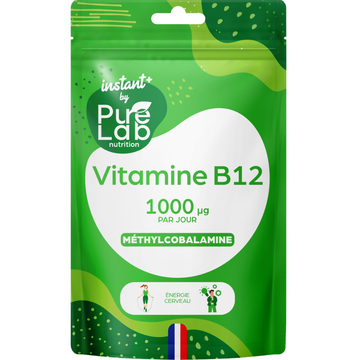
🧠 Our Vitamine B12 Instant+
✅ 1,000 µg of vitamin B12 per capsule, in the form of methylcobalamin
✅ 1 capsule per day, 30-day course in pocket format
✅ Vegetable capsules, suitable for vegans
👉 Discover our Vitamine B12 Instant+ here.
Signs that should alert you
A lack of vitamin B12 often sets in slowly. Possible signs are varied and non-specific:
- Persistent fatigue, weakness, shortness of breath
- Tingling or numbness in the hands and feet
- Memory issues or concentration problems
- Irritability or low mood
- Red and painful tongue, sometimes with mouth ulcers
- Headaches, palpitations, vision problems, loss of appetite
- Balance issues and coordination problems, muscle weakness
The NHS reminds us that these symptoms generally appear gradually, and that some neurological damage can become irreversible if the deficiency is not addressed. The longer it lasts, the greater the risk of long-term effects: this is why tingling, numbness, or balance issues should lead you to consult quickly, without delay.
These signs can have many other causes. Only a blood test prescribed by a doctor can confirm a deficiency. If fatigue is your main concern, our article Persistent fatigue: which deficiencies should you check? will help you prepare for your consultation.
Diagnosis and treatment
Diagnosis is based on your symptoms and a blood test prescribed by your doctor. Your doctor will also investigate the cause of the deficiency, as this determines the next steps.
| Origin of deficiency | Treatment described by the NHS |
|---|---|
| Diet-related | Daily B12 tablets or spaced-out injections; for vegans, sometimes tablets for life |
| Non-diet-related (pernicious anemia…) | Regular injections, generally for life |
| With neurological signs | Specialized advice and more frequent injections |
According to the NHS, a blood check is often performed 7 to 10 days after starting treatment, then around 8 weeks, to verify that it is working.
⚠️ The folic acid trap
The NHS points out a little-known fact: a folic acid (vitamin B9) intake can improve certain symptoms to the point of masking an underlying B12 deficiency, which then continues to affect the nervous system. This is why the doctor checks the B12 level before prescribing folic acid, and another reason to report all your supplements to them, including multivitamins.
Common mistakes
- Relying on spirulina: like other blue-green algae, it mainly contains a pseudo-B12, which is inactive in humans
- Waiting for symptoms to act when vegan: by this stage, reserves are already depleted
- Self-diagnosing based on fatigue: this has many possible causes, hence the value of medical advice
- Not mentioning your supplements to your doctor before a check-up: this skews the interpretation
- Ignoring the impact of certain medications: proton pump inhibitors and metformin are particularly concerned; talk to your doctor if you take them long-term
What to do if you are in doubt?
- Consult your doctor, especially in the event of tingling or memory issues: a significant deficiency must be addressed medically
- If you are vegan, regular supplementation is essential, without waiting for symptoms
👩 A concrete case
Sarah, 34, vegan for two years, feels fit and has never taken B12. Yet, this is the profile the NHS considers at risk. The right approach: talk to your doctor, do a blood check if they deem it useful, then incorporate a B12 supplement into a daily ritual.
Frequently asked questions
❓ Why does a supplement contain much more than 4 µg?
The adequate intake of 4 µg set by the EFSA concerns the total diet. However, active absorption of B12 saturates quickly: according to the review by Temova Rakuša et al. (2022), it goes from about 50% for a dose of 1 µg to less than 10% around 20 µg, and around 1% for doses of 500 µg and more. This same review indicates that high doses are considered safe, as the EFSA has not set an upper limit. If in doubt, ask your doctor or pharmacist for advice.
❓ Is a supplement enough in case of an proven deficiency?
Not necessarily. A significant deficiency, especially with neurological signs, requires medical treatment. A dietary supplement is intended for healthy people who wish to secure their intake.
❓ Can fortified foods be enough?
They can help: the NHS cites certain breakfast cereals, soy-based products, or fortified yeast extracts, suggesting to check their content on the label. A supplement has the advantage of providing a known dose, every day.
❓ Does a normal blood test exclude all problems?
Most often, yes. However, the NHS describes a rare case, "functional" deficiency: the blood level seems normal, but a defect in the proteins that transport B12 between cells prevents them from benefiting from it. If neurological signs persist despite a reassuring check-up, do not hesitate to talk about it with your doctor again.
❓ Is methylcobalamin preferable to cyanocobalamin?
Both forms are effective in correcting a deficiency. Methylcobalamin is an active form naturally present in the body, which avoids a conversion step. Some authors prefer it for long-term use. To learn more, read Methylcobalamin or cyanocobalamin: which form to choose?
❓ How long before feeling an effect?
In case of mild deficiency, the first improvements in fatigue or concentration can be felt in a few weeks. A proven deficiency, with neurological signs, requires medical management and a much longer duration of treatment. For simply securing intake, regularity counts more than speed.
In summary
1️⃣ An essential vitamin for energy, the nervous system, and red blood cells
2️⃣ Almost only of animal origin, and a deficiency that sets in slowly
3️⃣ Vegans, seniors, certain medical situations, and certain treatments: the at-risk profiles
4️⃣ In doubt? A blood test with your doctor
5️⃣ Methylcobalamin: an active and bioavailable form for rational daily supplementation
Pure Lab Nutrition ... The art of nourishing your well-being.
Sources:
- EFSA (2015). Dietary reference values: vitamin E and cobalamin. efsa.europa.eu
- ANSES (2025). Vegetarian diets: health effects and dietary guidelines. anses.fr
- Regulation (EU) No 432/2012 establishing a list of permitted health claims. EUR-Lex
- NHS. Vitamin B12 or folate deficiency anaemia – Causes. nhs.uk
- NHS. Vitamin B12 or folate deficiency anaemia – Symptoms. nhs.uk
- Temova Rakuša Ž., Roškar R., Hickey N., Geremia S. (2022). Vitamin B12 in Foods, Food Supplements, and Medicines — A Review of Its Role and Properties with a Focus on Its Stability. Molecules, 28(1), 240. PMC
- NHS. Vitamin B12 or folate deficiency anaemia – Treatment. nhs.uk


Restez informé 🌿
Recevez nos derniers articles et conseils santé directement dans votre boîte mail.


