





















Sustainable weight loss: the role of caloric deficit and supplements
Store shelves are overflowing with products that promise to "burn fat." The reality is more nuanced: sustainable weight loss is primarily based on a moderate caloric deficit, high-quality nutrition, and habits that can be maintained over time. Let's look at the modest role a dietary supplement can play in this process.
📑 Contents
- The caloric deficit: the basic principle
- Why strict diets often fail
- The pillars of sustainable weight loss
- What about dietary supplements?
- Fiber and plants: what you need to know
- Choosing wisely: criteria and warning signs
🔬 The caloric deficit: the basic principle
Losing weight requires consuming less energy than you expend over time. This is known as a caloric deficit. This principle remains the foundation of all approaches, regardless of the composition of the diet: high in carbohydrates, fats, or proteins.
🧮 A more complex calculation than it seems
The old rule "7,700 kcal = 1 kg" is an approximation. Hall et al. (2011), in The Lancet, showed that the body adapts: as you lose weight, energy expenditure decreases, which slows progress over the weeks. Therefore, an identical deficit does not produce the same weight loss at every stage. This adaptation is normal and does not mean you are "doing it wrong."
🎯 Aim for a moderate deficit
A reasonable deficit, generally around 10 to 20% of energy requirements, is easier to maintain than a very restrictive diet. It better preserves energy, mood, and muscle mass. A slow pace is also a better indicator of sustainability.
📉 Why strict diets often fail
The difficulty is generally not losing weight, but keeping it off. Hall and Kahan (2018) point out that weight regain is common after weight loss, partly because appetite increases and energy expenditure decreases adaptively. In addition, there are behavioral and psychological factors: frustration, deprivation, and a complicated social life.
Some classic traps:
- eliminating entire food groups, which is difficult to maintain in the long term;
- skipping meals and then compensating in the evening;
- relying on "express" solutions, followed by weight regain;
- neglecting sleep, which influences appetite and fatigue;
- relying solely on the scale, without looking at waist circumference, energy, or performance.
For an overview, also read our article Weight loss: which supplements can really help?
🧱 The pillars of sustainable weight loss
Before considering a supplement, ensure the foundations are solid.
🥗 Satiating nutrition
Foods rich in fiber, protein, and water (vegetables, legumes, whole fruits, dairy or alternatives, eggs, fish, poultry) are more satiating for a given number of calories. Hall and Guo (2017) highlight that the quality of the diet influences how people eat, even if the determining factor for weight loss remains overall energy intake.
🏃 Daily movement
Physical activity contributes to energy expenditure and helps maintain muscle mass. Walking, stairs, cycling, or weight training are all levers. The important thing is to choose an activity you will enjoy doing six months from now.
😴 Sleep and stress
Insufficient sleep and chronic stress complicate the control of food cravings. Taking care of your nights is therefore indirectly part of the strategy. Our article on restorative sleep offers concrete paths.
💊 What about dietary supplements?
Let's be clear: no dietary supplement causes weight loss on its own, and none replaces a healthy lifestyle. Products that promise quick results without effort are not based on any serious evidence. In the European Union, health claims are regulated by Regulation (EU) No. 432/2012, and almost all so-called "fat burner" plants do not benefit from them.
🧪 What the literature shows
Systematic reviews of weight-loss supplements generally conclude that effects are weak, heterogeneous, or of limited clinical relevance, with trials of variable methodological quality. We detail this finding in Natural fat burners: what really works (and what doesn't).
🧭 A supporting role
At best, a supplement acts as a small element of a routine: it can structure a habit, supplement the diet with nutrients, or provide fiber. It should never be used to justify an overly restrictive diet.
🌾 Fiber and plants: what you need to know
Dietary fiber is one of the few subjects where the science is solid: it increases the volume of the food bolus and slows digestion, which can promote satiety as part of a balanced diet. Slavin (2005) summarized this, noting that effects on weight remain modest and vary according to the individual and the type of fiber.
For regulatory information, the only weight-related fiber claim authorized by Regulation (EU) No. 432/2012 concerns glucomannan: it contributes to weight loss as part of a calorie-restricted diet, at a rate of 3 g per day, with sufficient water. For other plants, it is appropriate to remain descriptive. Also see Natural appetite suppressants: how fiber and plants help with satiety.
🚫 Products to avoid
Be wary of products sold without a clear composition, numerical promises ("-5 kg in 10 days"), undeclared stimulants, or products of unknown origin. Supplements are not recommended during pregnancy or breastfeeding, or for people with an eating disorder, without medical advice.
🔍 Choosing wisely: criteria and warning signs
- Transparent composition: ingredients and doses readable on the label (see How to read a dietary supplement label).
- No miracle promises: honest discourse talks about support, never guaranteed results.
- A realistic goal: 0.25 to 0.75 kg per week for most overweight adults, without excess.
- Medical advice if you have a high BMI, a medical condition, are on medication, or if you have lost weight without intending to.
To choose between the two formulas in the range, our comparison Burn & Fit or Burn & Cut: which one to choose according to your goal? helps you take stock.
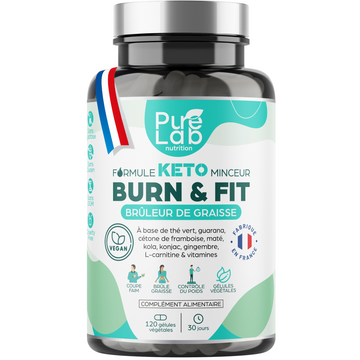
✅ Our Burn & Fit at Pure Lab Nutrition: a natural formula based on plants and vitamins in 120 vegan capsules, to be integrated as a supplement to a balanced diet and an active lifestyle.
👉 Discover our Burn & Fit here.
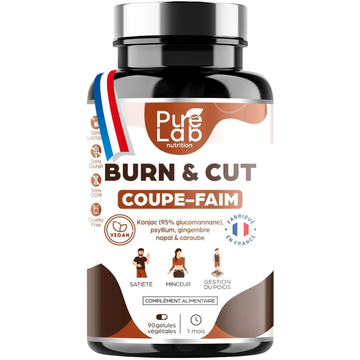
✅ Our Burn & Cut at Pure Lab Nutrition: a formula based on plants and fiber in 90 vegan capsules, designed as subtle support for your habits, never as a substitute.
👉 Discover our Burn & Cut here.
✅ In summary
1️⃣ Weight loss is primarily based on a moderate and sustainable caloric deficit, not a product.
2️⃣ The hardest part is maintenance: simple habits are better than an extreme diet.
3️⃣ No supplement replaces nutrition, physical activity, and sleep; be wary of numerical promises.
4️⃣ In case of doubt, pathology, or treatment, seek the advice of a healthcare professional.
Pure Lab Nutrition — The art of nourishing your well-being.
Scientific sources:
- Hall KD, Sacks G, Chandramohan D, et al. Quantification of the effect of energy imbalance on bodyweight. Lancet. 2011;378(9793):826-837.
- Hall KD, Kahan S. Maintenance of lost weight and long-term management of obesity. Med Clin North Am. 2018;102(1):183-197.
- Hall KD, Guo J. Obesity energetics: body weight regulation and the effects of diet composition. Gastroenterology. 2017;152(7):1718-1727.
- Slavin JL. Dietary fiber and body weight. Nutrition. 2005;21(3):411-418.


Restez informé 🌿
Recevez nos derniers articles et conseils santé directement dans votre boîte mail.