


























Creatine and muscle gain: protocol and scientific reality
Creatine is one of the most studied sports supplements in the world. But between loading protocols, maintenance doses, and promises of express muscle gain, it is easy to get lost. Here is what science actually says, and how to use it in a simple and reasonable way.
📑 Contents
- Creatine: what is it?
- Creatine and muscle gain: what is realistic
- Loading protocol: how it works
- Maintenance dose: the simple path
- Safety, common misconceptions, and precautions
- Setting up your routine
🔬 Creatine: what is it?
Creatine is a molecule that the body produces in part by itself (liver, kidneys, pancreas) and which is found in meat and fish. About 95% of the body's creatine is stored in the muscles, mainly as phosphocreatine, a reserve used during brief and intense efforts.
⚡ A role in muscular energy
During a sprint or a heavy set, phosphocreatine helps to rapidly regenerate ATP, the cell's "energy currency." Supplementation increases muscle stores, which explains its benefit in strength and explosive sports.
📋 The authorized claim
In the European Union, the claim authorized by Regulation (EU) No 432/2012 is as follows: creatine increases physical performance during successive, short-term, high-intensity exercises. The beneficial effect is obtained with a daily consumption of 3 g of creatine, for adults over 18 years of age performing this type of exercise.
💪 Creatine and muscle gain: what is realistic
Creatine is not a "muscle-building product" on its own. It does not create muscle without training or sufficient intake. Its value is indirect: it can help produce a little more work during sessions, which, when repeated over time and combined with an adequate diet, can support progress.
📊 What the data shows
The position of the International Society of Sports Nutrition (Kreider et al., 2017) concludes that creatine monohydrate is the most effective supplement form currently available for increasing high-intensity exercise capacity and lean mass during training. The meta-analysis by Branch (2003) reports, on average, a greater gain in lean mass and performance with creatine than with a placebo. Wax et al. (2021) confirm this finding while noting that the response varies from one person to another.
💧 Watch the weight on the scale
Part of the weight gain observed at the beginning of a cycle is linked to water stored in the muscle. It is neither fat nor, strictly speaking, new muscle. Lasting gains in lean mass require weeks of work and sufficient energy and protein intake. We cover these points in Creatine: hair, kidneys, water retention… separating fact from fiction.
🚀 Loading protocol: how it works
The classic protocol starts with a loading phase intended to rapidly saturate the muscles. Hultman et al. (1996) showed that about 20 g per day for 5 to 6 days significantly increases muscle creatine content, an effect that can then be maintained with low doses.
📏 Usual benchmarks
- Loading: approximately 0.3 g per kilo of body weight per day (i.e., about 20 g for 70 kg), divided into 4 doses of 5 g, for 5 to 7 days.
- Maintenance: 3 to 5 g per day thereafter, in a single dose.
These values are those reported by Kreider et al. (2017). Loading is sometimes associated with digestive issues (bloating, discomfort), especially if you take 20 g at once.
⚖️ Is loading necessary?
No. It only serves to accelerate saturation. If you are not in a hurry, a lower daily dose will lead to the same level of reserves, just more slowly.
📅 Maintenance dose: the simple path
Hultman et al. (1996) observed that taking about 3 g per day for 28 days led to a muscle creatine content comparable to that of a loading protocol. In other words, without loading, saturation is reached in about a month. This is the simplest approach, the best tolerated, and the easiest to maintain.
🕓 When to take it?
The time of day is secondary: consistency matters more. Some studies suggest a slight advantage to taking it around training, but the main thing is not to forget. On rest days, continue taking it. Creatine dissolves in water, juice, or a shake, and can be taken with a meal.
To compare 3 g and 5 g, read Creatine 3 g or 5 g: why studies recommend the minimum effective dose.
🛡️ Safety, common misconceptions, and precautions
In healthy adults, at standard doses, creatine monohydrate is one of the best-documented supplements. Kreider et al. (2017) and Antonio et al. (2021) do not report any harmful effect on kidney function in healthy subjects during proper use, including over several years in some studies. They also note that creatine increases serum creatinine, a marker sometimes used to evaluate the kidneys, without this automatically reflecting damage.
🧩 Common misconceptions
- "Creatine is a steroid": false, it is a molecule naturally present in the body and in the diet.
- "It is reserved for men": false. See Creatine for women: benefits, dosage, and misconceptions.
- "You have to cycle it": no solid data requires systematic breaks in healthy subjects.
⚠️ Who should seek advice?
People with kidney disease, treatments likely to affect the kidneys, or any chronic condition must ask their doctor for advice before starting. Creatine is not intended for minors without medical advice, nor is it recommended during pregnancy or breastfeeding due to a lack of sufficient data. Drink regularly throughout the day.
🧭 Setting up your routine
For realistic muscle gain, creatine is just one link. Here is the order of priority:
- A moderate caloric surplus (around 5 to 10% above your needs) to limit fat gain.
- Sufficient protein, around 1.6 to 2 g per kilo of body weight per day for most practitioners.
- Progressive resistance training, 3 to 5 times a week.
- Sleep and recovery, because that is where the adaptations happen.
- Creatine, 3 g per day minimum, consistently.
To learn more, check out Which supplements for effective muscle gain? and Creatine monohydrate: optimize your performance. Be patient: the effects of creatine are measured in weeks, not days.
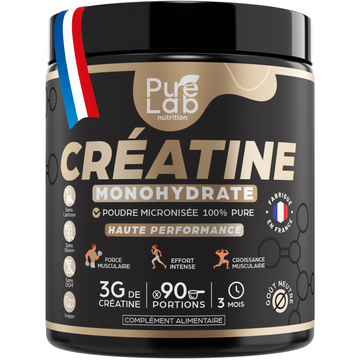
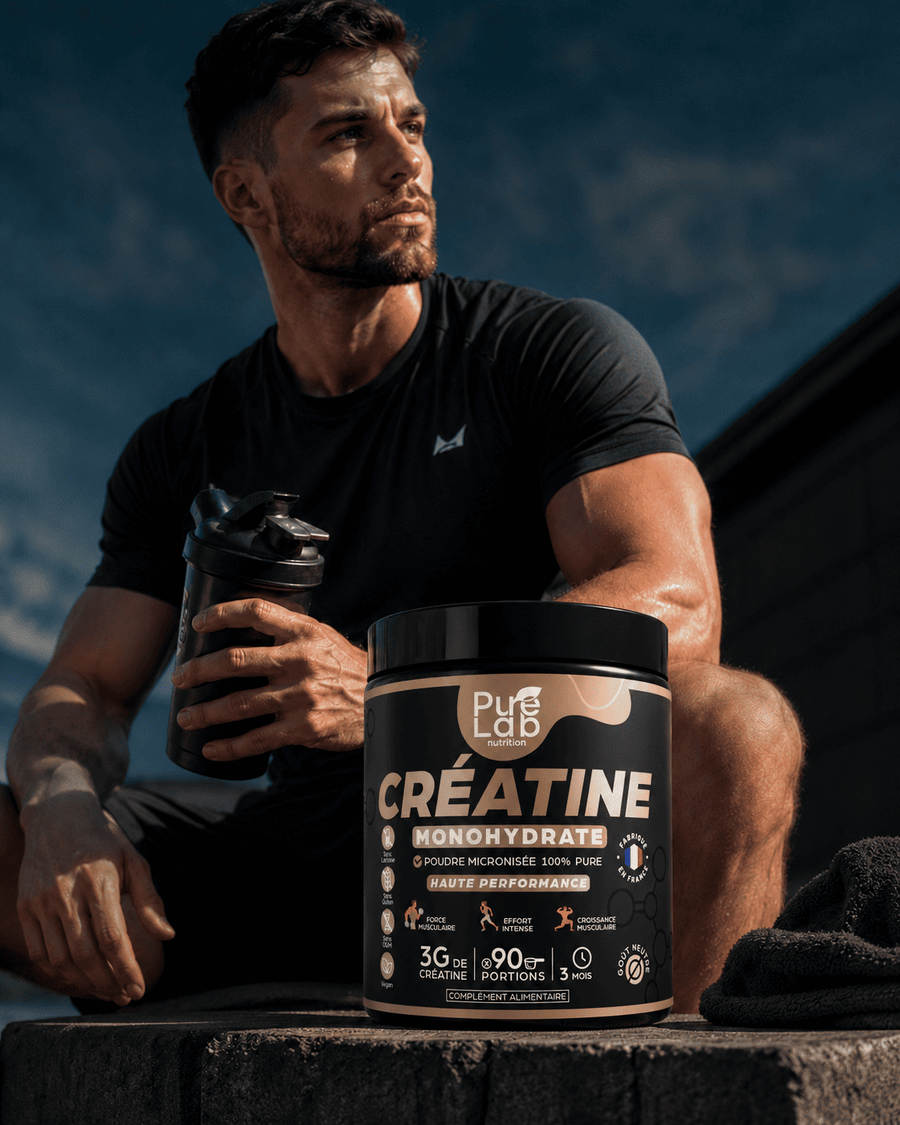
✅ Our Pure Lab Nutrition Creatine Monohydrate: a micronized, 100% pure creatine monohydrate powder, in 90 servings, for simple and consistent daily intake.
👉 Discover our Creatine Monohydrate here.
✅ In summary
1️⃣ Creatine monohydrate is the best-documented creatine supplement; 3 g per day corresponds to the authorized EU claim for performance during intense and repeated exercises.
2️⃣ Loading (about 20 g per day for 5 to 7 days) accelerates saturation but is not mandatory; 3 to 5 g per day is sufficient in about a month.
3️⃣ Part of the initial weight gain is intramuscular water; lean mass is built with training, protein, and patience.
4️⃣ In case of kidney pathology or medical treatment, seek your doctor's advice before starting.
Pure Lab Nutrition — The art of nourishing your well-being.
Scientific sources:
- Kreider RB, Kalman DS, Antonio J, et al. International Society of Sports Nutrition position stand: safety and efficacy of creatine supplementation in exercise, sport, and medicine. J Int Soc Sports Nutr. 2017;14:18.
- Hultman E, Soderlund K, Timmons JA, Cederblad G, Greenhaff PL. Muscle creatine loading in men. J Appl Physiol. 1996;81(1):232-237.
- Branch JD. Effect of creatine supplementation on body composition and performance: a meta-analysis. Int J Sport Nutr Exerc Metab. 2003;13(2):198-226.
- Antonio J, Candow DG, Forbes SC, et al. Common questions and misconceptions about creatine supplementation: what does the scientific evidence really show? J Int Soc Sports Nutr. 2021;18:13.
- Wax B, Kerksick CM, Jagim AR, Mayo JJ, Lyons BC, Kreider RB. Creatine for exercise and sports performance, with recovery considerations for healthy populations. Nutrients. 2021;13(6):1915.


Restez informé 🌿
Recevez nos derniers articles et conseils santé directement dans votre boîte mail.