
























Creatine in capsules or powder: which form should you choose?
Practical capsules or classic powder? The choice of creatine form often divides athletes. Here is a clear comparison, supported by scientific literature, to choose the form that truly fits your daily life.
📑 Table of contents
- What science says about creatine
- The key point: the actual dose of creatine
- Powder: benefits and limitations
- Capsules: benefits and limitations
- Absorption, efficacy: is there a difference?
- So, which form should you choose based on your profile?
🔬 What science says about creatine
Creatine is one of the most studied sports supplements in the world. It is a molecule naturally present in muscle that participates in the rapid regeneration of ATP, the energy source used during short and intense efforts. The body produces it, and it is provided through the diet via meat and fish.
From a regulatory perspective, a claim is authorized by Regulation (EU) No 432/2012: creatine increases physical performance in successive bursts of short-term, high-intensity exercise. The beneficial effect is obtained with a daily intake of 3 g of creatine, and the claim concerns adults performing this type of exercise.
📚 Significant scientific backing
The International Society of Sports Nutrition (ISSN) concludes that creatine monohydrate is the most effective and well-documented form for increasing muscle stores and supporting performance during intense efforts, with a good safety profile in healthy adults at usual doses (Kreider et al., 2017). An earlier meta-analysis had already shown an average improvement in performance on short and repeated efforts (Branch, 2003).
The whole question is therefore as follows: for the identical molecule, which presentation should you choose? That is what we detail below.
⚖️ The key point: the actual dose of creatine
Before comparing formats, you must look at one thing only: the amount of creatine actually provided per day. The label often indicates a dose per capsule, a dose per serving, and a number of servings. If you do not reach 3 g per day, you are not within the scope of the claim.
💊 On the capsule side
A creatine capsule generally contains between 500 mg and 1 g of creatine. To reach 3 g, you must therefore swallow three to six capsules per day, sometimes more depending on the brand. It is advisable to calculate what the daily dose indicated by the manufacturer actually represents.
🥄 On the powder side
With a powder, the amount can be adjusted to the exact dose. A scoop of approximately 3 to 3.5 g covers the reference daily intake in a single dose, without having to count capsules. This is one of the major assets of this format.
🥄 Powder: benefits and limitations
Creatine monohydrate powder remains the reference format in studies, which explains its popularity. It offers several concrete advantages.
- Precise and flexible dosing: you can adjust the dose to the gram, including for people who prefer to start gradually.
- Quantity/price ratio: pure creatine powder is generally more economical per gram, as there are no capsules or unit packaging.
- Simple composition: a micronized monohydrate powder can contain only creatine, which makes the label easier to read.
- Easy integration: it dissolves in water, juice, a shake, or yogurt.
It also has its limitations: you have to dose it, mix it, and it is slightly less easy to carry when traveling. Non-micronized powder may dissolve less well and leave grains at the bottom of the glass. Finally, some people do not like the texture, even if a flavorless powder is unnoticed in a drink.
💊 Capsules: benefits and limitations
Capsules are attractive for their practical and discreet side. They have their audience, and it is legitimate.
- No preparation: you swallow, that's it, without mixing or measuring.
- Easy transport: a pill box is enough for the office, the gym, or a trip.
- No taste: useful for those who cannot stand the texture of a thick drink.
In return, the cost per gram is generally higher, the number of capsules to take can be discouraging (three to six per day to reach 3 g), and the shell as well as the excipients add components that are not always necessary. Finally, reading a label requires vigilance: some indicate the dose "per capsule" whereas the recommended daily dose is much higher.
To correctly read this information, our guide How to read the label of a dietary supplement is a good starting point.
🧪 Absorption, efficacy: is there a difference?
Fundamentally, the pharmaceutical form (capsule or powder) does not change the molecule. What matters is the chemical form and the dose. Creatine monohydrate is very well absorbed in the intestine, and available data do not show a demonstrated advantage for forms presented as "new" or "more assimilable," such as esters or buffered forms (Jäger et al., 2011; Antonio et al., 2021).
🧭 The marketing trap
Beware of promises like "no water retention," "no loading phase," or "10 times more assimilable." These arguments are rarely supported by independent trials. The few received ideas about creatine (hair, kidneys, water retention) are also addressed in our article Creatine: hair, kidneys, water retention... fact vs. fiction.
⏱️ Loading or daily intake?
Muscle saturation can be achieved in a few days with a loading phase, or in a few weeks with a lower, regular intake (Hultman et al., 1996). For the majority of adults, a simple daily intake is sufficient. Our article Creatine 3g or 5g details what studies say about the minimum effective dosage.
✅ So, which form should you choose based on your profile?
There is no universal correct answer, but some simple benchmarks.
- You want a precise dosage and good value for money: monohydrate powder is the most logical solution.
- You travel a lot or cannot stand drinks: capsules can facilitate consistency, provided you count the capsules to reach 3 g.
- You are a beginner: choose simplicity, a single daily intake, at a fixed time.
- You are a female athlete: the principles are identical. Our article Creatine for women answers common questions.
The essential thing remains consistency: it is better to have a form that you take every day than a "perfect" form abandoned after two weeks. To integrate creatine into an overall routine, also consult Which supplements for athletes? The routine according to your practice.
Precautions: creatine is intended for adults. Drink enough throughout the day, and seek medical advice if you have a health issue, particularly renal, or if you are taking medication.
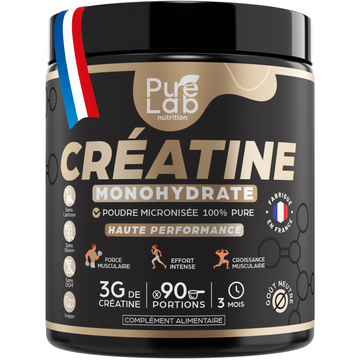
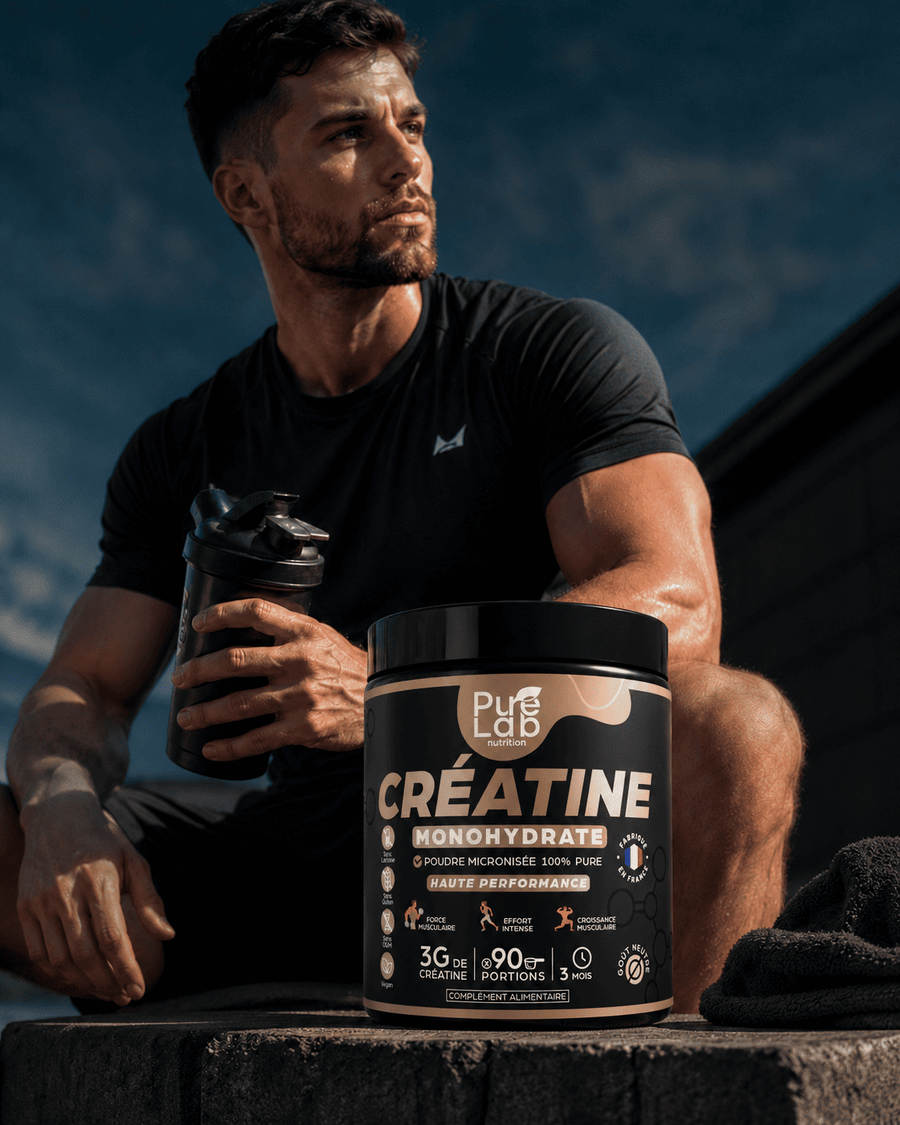
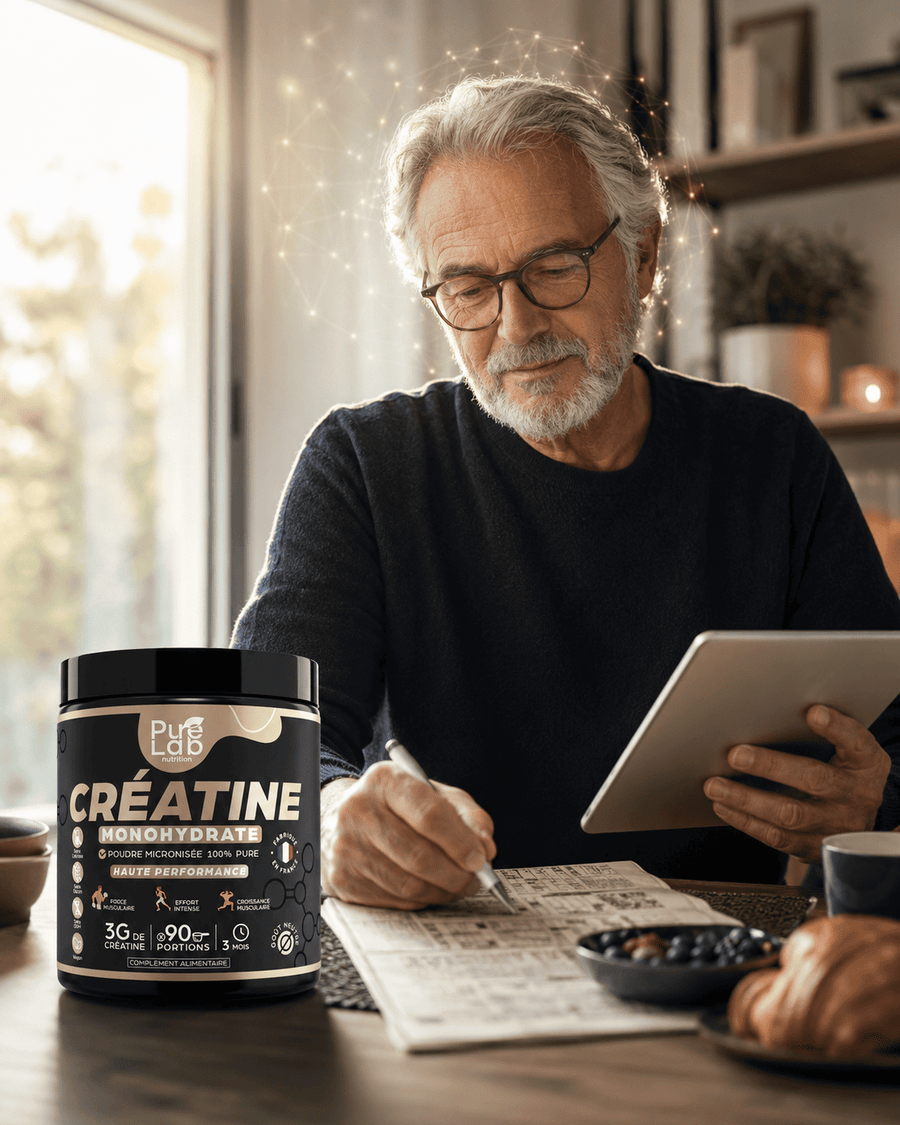
✅ Our Creatine monohydrate at Pure Lab Nutrition: a micronized creatine monohydrate powder, with 3.4 g per serving and 90 servings per container, with a neutral taste. Creatine increases physical performance in successive bursts of short-term, high-intensity exercise (effect obtained by a daily consumption of 3 g, in adults).
👉 Discover our Creatine monohydrate here.
✅ In summary
1️⃣ Creatine monohydrate is the most studied form, with a European claim for short and repeated intense efforts (3 g per day).
2️⃣ Powder and capsules provide the same molecule: the difference lies in the dose, the price, and the convenience.
3️⃣ Powder offers precise dosing and better value for money, while capsules focus on ease of use.
4️⃣ Avoid marketing promises about "new" forms: consistency matters more than the format.
Pure Lab Nutrition — The art of nourishing your well-being.
Scientific sources:
- Kreider RB, Kalman DS, Antonio J, et al. International Society of Sports Nutrition position stand: safety and efficacy of creatine supplementation in exercise, sport, and medicine. Journal of the International Society of Sports Nutrition. 2017;14:18.
- Antonio J, Candow DG, Forbes SC, et al. Common questions and misconceptions about creatine supplementation: what does the scientific evidence really show? Journal of the International Society of Sports Nutrition. 2021;18:13.
- Branch JD. Effect of creatine supplementation on body composition and performance: a meta-analysis. International Journal of Sport Nutrition and Exercise Metabolism. 2003;13(2):198-226.
- Jäger R, Purpura M, Shao A, Inoue T, Kreider RB. Analysis of the efficacy, safety, and regulatory status of novel forms of creatine. Amino Acids. 2011;40(5):1369-1383.
- Hultman E, Söderlund K, Timmons JA, Cederblad G, Greenhaff PL. Muscle creatine loading in men. Journal of Applied Physiology. 1996;81(1):232-237.


Restez informé 🌿
Recevez nos derniers articles et conseils santé directement dans votre boîte mail.