

















Zinc and acne: what can you really expect?
Returning breakouts, oily skin, lingering marks: you’ve surely heard that zinc could help. This is partly true, provided you clearly distinguish between what constitutes a medicine and what constitutes a food supplement.
At Pure Lab Nutrition, we prefer to be clear with you. Here is what zinc can do for skin prone to imperfections, what it cannot do, and the mistakes to avoid so you don’t waste your time.
📑 Table of Contents
- Acne in a nutshell
- Zinc and acne: what the studies say
- Medicine or supplement: the real difference
- A global routine for clear skin
- Common mistakes
- Common misconceptions: truth or myth
- Frequently asked questions
- In summary
Acne in a nutshell
Acne is a very common skin condition, especially during adolescence, but it can also affect adults. It results from several combined mechanisms: excessive sebum production, clogged pores, bacterial proliferation, and inflammation. Hormones, genetics, and stress also play a role.
We distinguish between retentional lesions (blackheads, microcysts) and inflammatory lesions (red pimples, pustules). It is primarily the latter that zinc has been studied for.
🔎 Temporary imperfections or established acne?
A few pimples before your period or after a stressful period are not the same thing as acne that has lasted for months, leaves marks, or affects the back and chest. In the latter case, medical advice is essential: the earlier acne is managed, the more you limit the risk of scarring.
Zinc and acne: what the studies say
In 2020, a meta-analysis published in Dermatologic Therapy (Yee et al.) grouped together the available studies. Its conclusions:
- People suffering from acne have, on average, lower blood zinc levels
- Zinc reduced the number of inflammatory lesions more effectively, whether used alone or as an adjunct to another treatment
- Side effects were no more frequent than with comparison treatments
Important note: these studies involve patients with acne, using dosages and a framework that are often medical. They do not mean that a food supplement cures acne.
✅ What can be said about a zinc supplement
At the European level, zinc contributes to the maintenance of normal skin and protects cells against oxidative stress. This is the authorized framework for a food supplement: supporting normal skin, not treating a skin disease.
Medicine or supplement: the real difference
| Zinc medication | Food supplement | |
|---|---|---|
| Goal | Treat mild to moderate inflammatory acne | Contribute to the maintenance of normal skin |
| Dosage | Example: 30 mg of zinc per day for 3 months, then 15 mg | Nutritional dose (15 mg per day for our formulas) |
| Framework | Upon medical advice | As a complement to a varied diet |
The medication dosage example above is for a zinc gluconate-based medication marketed in France, as described in the public database of medicines. This medication carries precautions: for example, it must be taken away from iron, calcium, and certain antibiotics.
To put these doses into perspective: the ANSES (French Agency for Food, Environmental and Occupational Health & Safety) sets an upper safety limit for adults of 25 mg of zinc per day, from all sources combined. This is one of the reasons why higher doses require medical monitoring.
💡 Our position
If you have established acne, consult a doctor or a dermatologist. A zinc food supplement has its place in supporting normal skin on a daily basis, especially if your diet provides little of it, but it does not replace a treatment.
A global routine for clear skin
🧴 Daily habits
- Cleanse gently, morning and evening, without stripping the skin
- Moisturize, even oily skin, with a non-comedogenic product
- Do not pick at pimples, to avoid leaving marks
- Protect from the sun, which can accentuate marks
To better understand your skin before choosing your skincare, read Skin type: identifying and understanding your epidermis.
🍽️ Lifestyle
A varied diet rich in plants, sufficient sleep, and good stress management contribute to skin balance.
📝 A concrete example
Let's imagine Inès, 27, who has a few inflammatory pimples on her chin, especially during busy periods. She replaces her harsh cleanser with a gentle gel, stops touching her face at the office, goes to bed more regularly, and adds a nutritional dose of zinc bisglycinate to her breakfast. She sets a date with herself in three months, and plans to see a doctor if the lesions spread or leave marks.
💊 Zinc on a daily basis
Choose a well-absorbed form such as bisglycinate, and stick to the dose. To understand the differences between the forms, read Zinc bisglycinate, gluconate, or citrate: which form to choose?
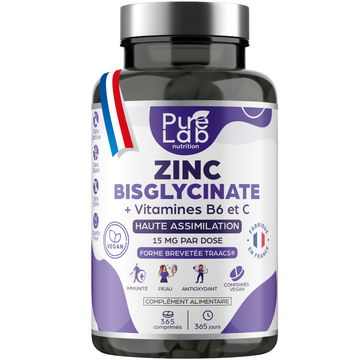
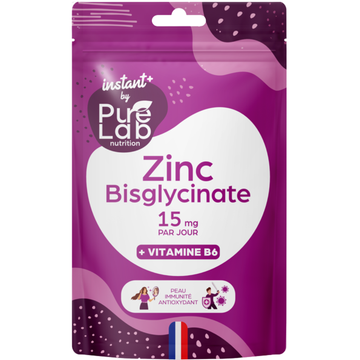
✅ Zinc Bisglycinate: 15 mg of zinc per day, with vitamins B6 and C
✅ Zinc Bisglycinate Instant+: 15 mg of zinc + B6, in pocket format
✅ Vegan formulas, lactose-free and gluten-free
👉 Discover our Zinc Bisglycinate here.
Common mistakes
- Combining a zinc medication and a zinc supplement without talking to your doctor: the doses add up
- Increasing the dose yourself to mimic medical dosages
- Expecting results in a week: the skin renews itself over several weeks
- Overusing aggressive skincare (daily scrubs, drying products), which can irritate the skin
- Delaying consultation when acne is leaving marks
Common misconceptions: truth or myth
❌ "Oily skin does not need to be moisturized"
Myth. Oily skin can also be dehydrated, especially when attacked by cleansers that are too harsh. A light, non-comedogenic moisturizer helps it stay comfortable without aggravating imperfections.
❌ "The more I cleanse, the clearer my skin will be"
Myth. Repeated washing and drying products irritate the skin, which can maintain redness. Two gentle cleansings per day are sufficient in the vast majority of cases.
❌ "A zinc supplement replaces a medical consultation"
Myth. It supports the maintenance of normal skin, but it does not allow for a diagnosis, nor does it treat established acne. The earlier the care is initiated, the more you limit the risk of scarring.
✅ "Consistency matters more than intensity"
Truth. Whether it's skincare or a supplement, simple actions repeated every day for several weeks yield better results than complicated routines abandoned after ten days.
Frequently asked questions
❓ Can zinc make acne disappear?
A food supplement does not treat acne. Zinc contributes to the maintenance of normal skin; the treatment of acne is a matter for a healthcare professional.
❓ Can you take zinc with acne treatment?
Always ask your doctor or pharmacist for advice: some treatments interact with minerals, and you may already be receiving zinc.
❓ How long does it take to see results?
Count on at least two to three months of consistency, in parallel with gentle skincare and a healthy lifestyle.
❓ Can a teenager take a zinc supplement?
For children and teenagers, always seek advice from a doctor or pharmacist before giving a food supplement. In young people, acne is common and benefits primarily from management adapted by a healthcare professional.
In summary
1️⃣ Zinc is studied in the context of acne, especially for inflammatory lesions
2️⃣ Medication treats, while a supplement supports normal skin
3️⃣ Consult a professional in case of established acne
4️⃣ A global approach: gentle skincare, lifestyle, diet
Read also: the benefits of zinc for skin and hair and our natural allies for radiance.
Pure Lab Nutrition ... The art of nourishing your well-being.
Sources:
- Yee B.E., Richards P., Sui J.Y., Fleming Marsch A. (2020). Serum zinc levels and efficacy of zinc treatment in acne vulgaris: A systematic review and meta-analysis. Dermatologic Therapy, 33(6), e14252. PubMed
- Public database of medicines. Summary of product characteristics, zinc gluconate 15 mg capsule. medicaments.gouv.fr
- ANSES (2021). Nutritional references for vitamins and minerals. anses.fr
- Regulation (EU) No 432/2012 establishing a list of permitted health claims. EUR-Lex


Restez informé 🌿
Recevez nos derniers articles et conseils santé directement dans votre boîte mail.