

























Ashwagandha: benefits, dosage, and precautions, the complete guide
Mounting stress, restless nights, underlying fatigue: what if a millenary plant could help you regain your balance? In just a few years, ashwagandha has become one of the most sought-after plants in France. But between marketing promises and scientific reality, it is sometimes difficult to see clearly.
At Pure Lab Nutrition, we have sorted it out for you. In this guide, we explain what ashwagandha is, what the studies really show, how to take it according to your goals, and, most importantly, in which cases it is best to avoid it.
📑 Summary
- What is ashwagandha?
- What the studies really say
- How does it work? The hypotheses
- How to take ashwagandha?
- Three profiles, three ways to use it
- Precautions: who should avoid it?
- Choosing the right ashwagandha
- Common misconceptions: fact or fiction
- Frequently asked questions
- In summary
What is ashwagandha?
🌿 A plant of Ayurvedic tradition
Ashwagandha (Withania somnifera) is a small shrub in the Solanaceae family, native to India and North Africa. It is sometimes called "Indian ginseng," even though it has no botanical connection to ginseng. It is primarily its root that has been used for centuries in Ayurvedic medicine.
🧩 An "adaptogenic" plant
Ashwagandha is classified as an adaptogenic plant: plants traditionally used to help the body cope with stressful situations. Its most studied compounds are withanolides, which are present mainly in the root.
Be careful, however: the term "adaptogen" describes a traditional use, not a proven effect. And to date, no health claim is authorized for ashwagandha in the European Union. That is why it is essential to look at what clinical trials say, along with their strengths and limitations.
What the studies really say
😌 Stress: encouraging results
One of the most cited studies is a randomized, double-blind, placebo-controlled trial published in 2012 by Chandrasekhar and colleagues. 64 adults suffering from chronic stress received either a placebo or 600 mg per day of an ashwagandha root extract (KSM-66®) for 60 days.
- Perceived stress: significant decrease in stress questionnaire scores in the ashwagandha group
- Cortisol: decrease in blood levels of cortisol, the stress hormone, which was more marked than in the placebo group
Another trial, published in 2019 in the journal Medicine, tested a different extract at a dose of 240 mg per day in 60 stressed adults for 60 days. Compared to the placebo, the anxiety score assessed by a clinician and morning cortisol decreased more; the stress questionnaire completed by the participants, however, only showed a non-significant trend.
A word of caution: these are modest-sized studies, often supported by extract manufacturers. Their results point in the same direction, but they need to be confirmed by larger, independent trials.
😴 Sleep: a modest but measurable effect
In 2019, a trial published in Cureus (Langade et al.) followed 60 adults suffering from insomnia for 10 weeks, with 600 mg per day of KSM-66® extract or a placebo. Time to fall asleep and sleep efficiency, measured by a wrist-worn sensor, improved more in the ashwagandha group.
In 2021, a meta-analysis published in PLoS ONE (Cheah et al.) grouped 5 randomized trials, involving 400 participants. The conclusion: ashwagandha has a small but significant effect on overall sleep. The effect was more pronounced:
- in people suffering from insomnia
- with doses of at least 600 mg per day
- over durations of at least 8 weeks
The authors also note that long-term safety data remains limited. We detail this subject in our article Ashwagandha and sleep: what the studies really say.
📊 Key studies at a glance
| Study | Participants | Dose and duration | Main result |
|---|---|---|---|
| Chandrasekhar, 2012 | 64 stressed adults | 600 mg/day, 60 days | Perceived stress and cortisol down vs placebo |
| Trial published in Medicine, 2019 | 60 stressed adults | 240 mg/day, 60 days | Anxiety and morning cortisol down vs placebo |
| Langade, 2019 | 60 insomniac adults | 600 mg/day, 10 weeks | Faster sleep onset vs placebo |
| Cheah, 2021 (meta-analysis) | 5 trials, 400 participants | Variable | Small but significant effect on sleep |
⚖️ Key takeaways
Ashwagandha is not a miracle plant, but it is one of the best-studied adaptogenic plants. The results on stress and sleep are encouraging, provided that it is taken regularly for several weeks. It is in no way a substitute for medical follow-up for persistent sleep disorders or anxiety.
How does it work? The hypotheses
When facing stress, our body activates a hormonal regulation system that links the brain to the adrenal glands, which release cortisol. This is a normal and useful reaction in the short term. The problem arises when this system remains constantly engaged.
Researchers hypothesize that ashwagandha might help moderate this stress response: this is the hypothesis put forward by the authors of the trial published in Medicine, who observed a drop in morning cortisol. But this is a possible explanation, not a proven mechanism. Most importantly, remember this: the observed effects are gradual, measured in weeks, and vary from one person to another.
How to take ashwagandha?
💊 The dose
In studies, doses of root extract most often fall between 240 and 600 mg per day, depending on the extract used. Always follow the dose indicated on the product you are using: each extract has its own concentration, and a dose studied for one extract cannot automatically be applied to another.
⏰ The timing
- In the morning: if your goal is to better get through busy days
- In the evening: if your main goal is sleep
- With a meal: for better digestive comfort
📅 The duration
Expect at least 6 to 8 weeks of regular intake before judging the effects: this is the duration of most studies. A break is recommended afterward, and the advice of a healthcare professional is useful for any prolonged use, as safety data beyond a few months remains scarce.
📝 Tracking your course easily
To know if a course is truly helping you, note two or three simple markers each week: your stress level on a scale of 1 to 10, your time of falling asleep, your energy level upon waking. After two months, compare with the first week. This is much more reliable than an impression of the moment.
Three profiles, three ways to use it
💼 Marc, 42: a period of intense work
Marc is dealing with back-to-back urgent files and feels tense from the morning on. He takes his ashwagandha with breakfast, every day, for eight weeks. In parallel, he blocks out a real lunch break and walks for twenty minutes in the evening. He knows the plant won't erase his workload, but he gives himself a framework to better navigate it.
🌙 Julie, 35: nights that are too short
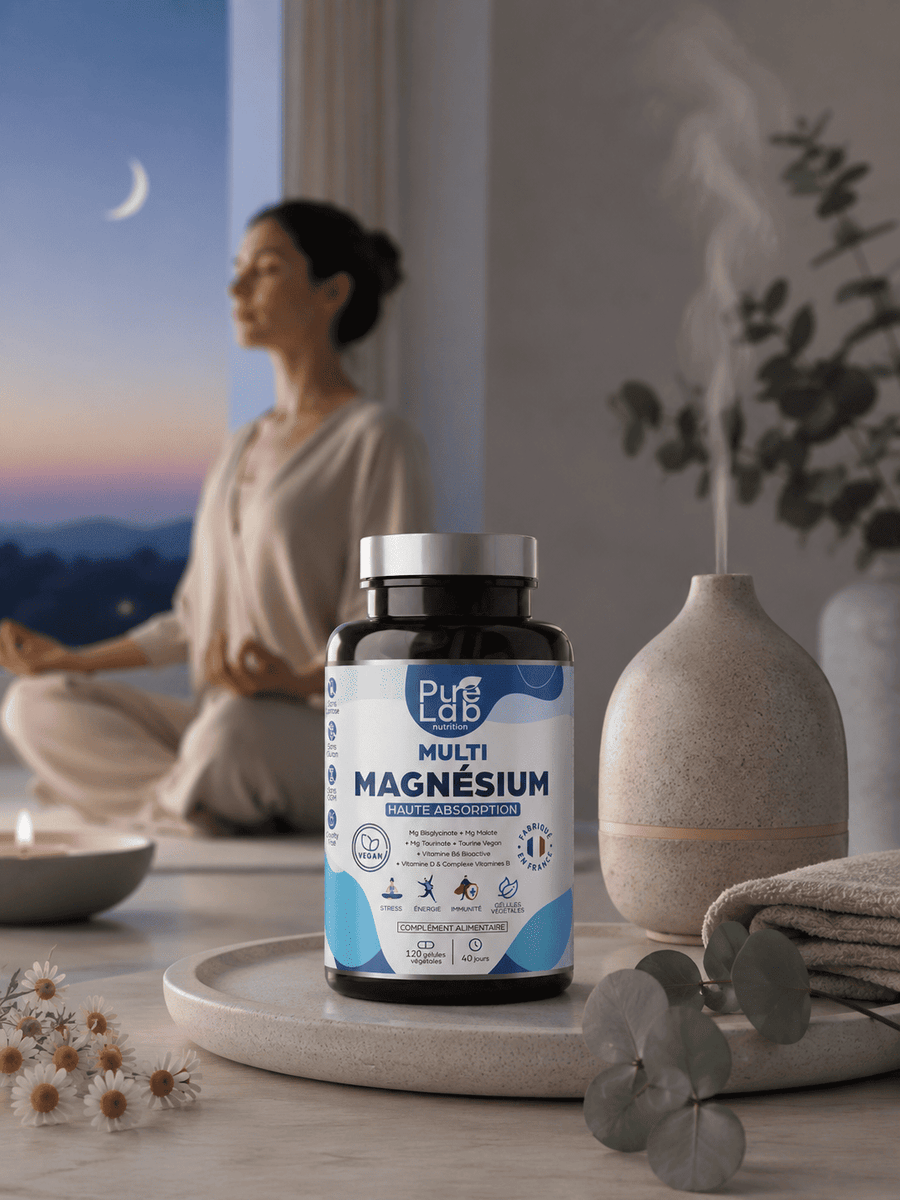
Julie takes a long time to fall asleep on weeknights. She takes her capsule at dinner, turns off screens an hour before bed, and maintains a regular schedule, even on weekends. She can also incorporate magnesium into her routine, which contributes to normal nervous system function and reduces fatigue. To learn more, read Ashwagandha and magnesium: combining them against stress.
🏃 Thomas, 28: a highly active athlete
Thomas trains five times a week on top of his work. Before adding ashwagandha, he checks the essentials: sufficient sleep, a suitable diet, and real rest days. If these bases are in place and he is not part of any discouraged demographic, he can integrate it into his evening routine without expecting a direct effect on his performance.
Precautions: who should avoid it?
This is the most important point in this guide. In April 2024, the ANSES (French Agency for Food, Environmental and Occupational Health & Safety) published an opinion on dietary supplements containing ashwagandha, after analyzing reported cases of adverse effects in France (digestive disorders, drowsiness, skin reactions, and one case of acute hepatitis).
🚫 ANSES advises against ashwagandha for
- pregnant or breastfeeding women
- minors under 18
- people suffering from thyroid disorders or hyperandrogenism
- people with liver or heart problems
- people taking sedative medications or medications that act on the central nervous system
⚠️ Good practices
- Ask your doctor or pharmacist for advice if you are on any treatment
- Stop taking it and consult a doctor in case of persistent digestive issues, jaundice, or unusual fatigue
- Do not exceed the indicated dose and do not combine multiple ashwagandha-based products
Choosing the right ashwagandha
Not all ashwagandha supplements are created equal. Here are the criteria to check:
- The part of the plant: opt for a root extract, the part traditionally used and most studied
- A standardized extract: the withanolide content must be indicated, which ensures constant composition from one batch to the next
- An identified extract: some branded extracts, like KSM-66®, have been the subject of published clinical trials
- Quality: organic farming, clear and detailed composition on the label
- Warnings: a serious brand reminds consumers which demographics should avoid the plant
To understand why the extract matters as much as the plant, read our article Ashwagandha KSM-66: why the extract matters.
🔬 Our ORGANIC Ashwagandha at Pure Lab Nutrition
✅ KSM-66® root extract, standardized to 5% withanolides
✅ 300 mg per day in a single capsule
✅ Certified Organic Agriculture
✅ A French brand: Pure Lab Nutrition
👉 Discover our ORGANIC Ashwagandha here.
Ashwagandha fits well into an overall stress management routine. To go further, also discover how magnesium acts on stress.
Common misconceptions: fact or fiction
❌ "It's natural, so it's risk-free"
False. An active plant can have adverse effects and interact with medications. The ANSES opinion clearly reminds us: "natural" does not mean "for everyone."
❌ "It works from the very first dose"
False. In trials, effects were measured after 8 to 10 weeks of daily use. Judging it after a few days makes no sense.
❌ "The higher the dose, the better"
False. Studies used precise doses for precise extracts. Exceeding the indicated dose provides no proven benefit and increases the risk of discomfort.
✅ "The quality of the extract matters"
True. A standardized root extract, with an indicated titration, allows you to know what you are taking and to compare it to published studies.
Frequently asked questions
❓ Can you take ashwagandha all year round?
Trials lasted two to three months. In the absence of solid long-term data, it is better to proceed in cycles, with breaks, and to ask a healthcare professional for advice for any prolonged use.
❓ Does ashwagandha cause daytime drowsiness?
Drowsiness is one of the adverse effects mentioned in the ANSES opinion. If you experience it, take your capsule in the evening and avoid driving until you know how your body reacts. If it persists, stop taking it.
❓ Can it be combined with magnesium?
Yes, this is a common combination in anti-stress routines. Magnesium contributes to normal psychological functions and the normal functioning of the nervous system.
❓ What should I do if I am on medication?
Talk to your doctor or pharmacist before starting, especially if you are taking treatment for the thyroid, an anxiolytic, a sleeping pill, or any medication that acts on the nervous system.
In summary
1️⃣ A seriously studied plant: encouraging results on stress and sleep
2️⃣ Consistency: minimum 6 to 8 weeks to judge the effects
3️⃣ A quality extract: root, standardized, ideally organic
4️⃣ Caution: to be avoided during pregnancy, under 18 years of age, and in cases of thyroid, liver, or heart disorders
When used properly, ashwagandha can find its place during busy periods. But like any active plant, it should be taken with discernment.
Pure Lab Nutrition ... The art of nourishing your well-being.
Sources:
- ANSES (2024). Opinion on the risks associated with the use of Withania somnifera (L.) Dunal preparations in food supplements. Request no. 2021-SA-0077. anses.fr
- Chandrasekhar K., Kapoor J., Anishetty S. (2012). A prospective, randomized double-blind, placebo-controlled study of safety and efficacy of a high-concentration full-spectrum extract of ashwagandha root in reducing stress and anxiety in adults. Indian Journal of Psychological Medicine, 34(3), 255-262. PMC
- (2019). An investigation into the stress-relieving and pharmacological actions of an ashwagandha (Withania somnifera) extract: A randomized, double-blind, placebo-controlled study. Medicine (Baltimore), 98(37), e17186. PubMed
- Langade D., Kanchi S., Salve J., Debnath K., Ambegaokar D. (2019). Efficacy and Safety of Ashwagandha (Withania somnifera) Root Extract in Insomnia and Anxiety: A Double-blind, Randomized, Placebo-controlled Study. Cureus, 11(9), e5797. PubMed
- Cheah K.L., Norhayati M.N., Yaacob L.H., Rahman R.A. (2021). Effect of Ashwagandha (Withania somnifera) extract on sleep: A systematic review and meta-analysis. PLoS ONE, 16(9), e0257843. PubMed
- Regulation (EU) No 432/2012 establishing a list of permitted health claims. EUR-Lex


Restez informé 🌿
Recevez nos derniers articles et conseils santé directement dans votre boîte mail.