



































Stress and sleep: which supplements, and how to combine them?
A stressful day, a restless night, followed by another even more difficult day… Stress and sleep form a well-known vicious circle. To break out of it, you must act on both simultaneously and accept that no supplement can replace healthy habits on its own.
At Pure Lab Nutrition, we offer a holistic approach. Healthy habits first, then supplements that have been studied, how to combine them throughout the day, concrete examples, and common mistakes to avoid.
📑 Table of Contents
- The stress-sleep vicious circle
- What happens in the body
- Habits that change everything
- Studied supplements
- How to combine them throughout the day
- Three profiles, three routines
- An eight-week plan
- Myths and reality
- Common mistakes
- Precautions
- Frequently Asked Questions
- Summary
The stress-sleep vicious circle
Stress keeps the body in a state of alert: racing thoughts, difficulty switching off, and nighttime awakenings. A poor night's sleep makes us more sensitive to stress the next day: we have lower tolerance for the unexpected and are prone to overcompensating with coffee. To break this cycle, you must act on the day just as much as on the evening.
🔄 Occasional or chronic stress?
A spike in stress related to an exam, a move, or a work deadline often disrupts sleep for a few nights, then everything returns to normal. When the tension lasts for weeks and nights remain short or fragmented, it becomes useful to review your overall organization, and sometimes to speak with a healthcare professional. Supplements find their place as support in this process, not as an isolated solution.
What happens in the body
Facing pressure, the body activates a stress response: heart rate accelerates, alertness increases, and certain hormones, including cortisol, are released. This is a useful short-term reaction that allows us to cope. The problem arises when it stays switched on for too long, especially in the evening, when the body should instead be winding down.
Sleep, meanwhile, depends on two mechanisms: the internal clock, regulated largely by light, and sleep pressure, which accumulates throughout the waking hours. A shifted bedtime, a late nap, or exposure to screens in the evening disrupts these two levers. This is why daytime habits weigh just as heavily as evening ones.
🔎 Where do nutrients intervene?
Magnesium and vitamin B6 contribute to the normal functioning of the nervous system: insufficient intake can therefore take a toll on how we handle fatigue and tension. Their role is to maintain this normal functioning, not to induce sleep. Ashwagandha is a plant studied for its effects on perceived stress and sleep, though it has no authorized health claims: its effects are found in clinical trials.
Habits that change everything
✅ Regular wake-up and bedtimes, even on weekends
✅ Natural light in the morning to set your internal clock
✅ Physical activity, preferably during the day rather than the evening
✅ No caffeine after the early afternoon
✅ Fewer screens in the hour before bed
✅ A calming ritual: reading, slow breathing, stretching
🛏️ A bedroom that invites rest
A cool, dark, and quiet room facilitates falling asleep. And if you have been unable to sleep for a long time, it is better to get up and engage in a calm activity in soft light rather than lying in bed ruminating.
Studied supplements
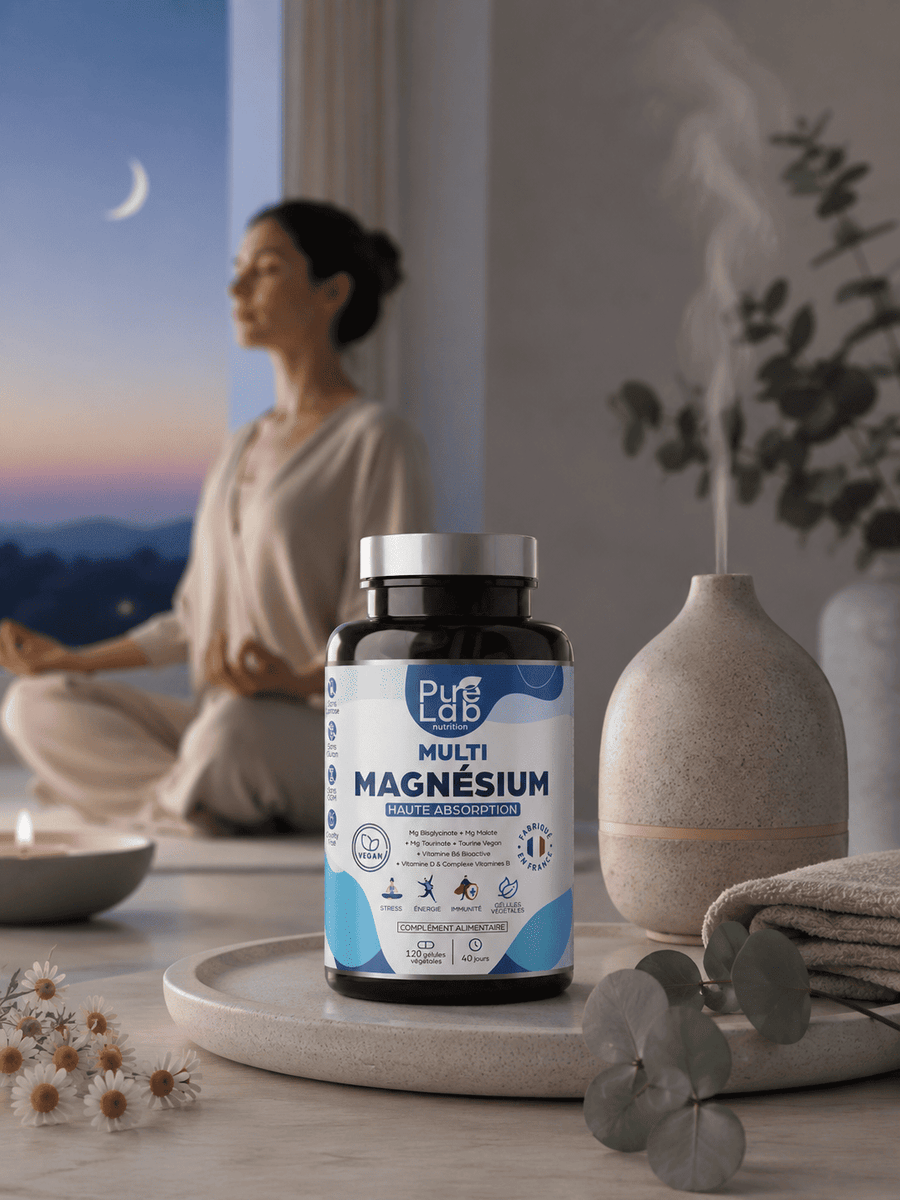
🧂 Magnesium + vitamin B6
Magnesium and vitamin B6 both contribute to normal psychological functions, the normal functioning of the nervous system, and the reduction of fatigue. In a randomized trial published in 2018 in PLoS ONE, 264 stressed adults with low blood magnesium levels saw their stress scores drop by about 45% over 8 weeks, using either magnesium alone or combined with B6. For those most stressed, the combination with B6 yielded better results. Note: these results apply to people who had low blood magnesium; they do not automatically apply to everyone. To learn more, read How does magnesium act on stress?
🌿 Ashwagandha
Ashwagandha is a plant used in Ayurvedic medicine. It does not benefit from any authorized health claims in the European Union: we are therefore discussing studies and their limitations. Regarding stress, a trial published in 2012 in the Indian Journal of Psychological Medicine (Chandrasekhar et al.) tracked stressed adults for 60 days: their cortisol levels decreased more under ashwagandha than under placebo. Regarding sleep, a meta-analysis published in 2021 in PLoS ONE (Cheah et al.), grouping 5 randomized trials and 400 participants, found a small but significant effect of ashwagandha on sleep, more pronounced in people suffering from insomnia, at a dose of at least 600 mg per day over 8 weeks or more. In a trial on insomnia (Langade et al., 2019), conducted on 60 adults with 600 mg per day of KSM-66 extract for 10 weeks, sleep onset latency and sleep efficiency improved more than with a placebo. Read Ashwagandha and sleep: what the studies say.
⚖️ Key takeaways
Always check the type of extract and the dosage used in studies before comparing a product. Our Organic Ashwagandha uses KSM-66 root extract, standardized to 5% withanolides, at 300 mg per capsule: follow the dosage indicated on the label. These effects remain modest and require consistency: we are talking about weeks, not one night. The studies involve specific populations (stressed adults, insomniacs), with defined doses and durations.
How to combine them throughout the day
| Time | Habit | Supplement |
|---|---|---|
| Morning | Daylight, breakfast | — |
| Noon | Walk, break | Ashwagandha (if the goal is primarily stress) |
| Dinner | Light meal | Magnesium + B6; ashwagandha if the goal is primarily sleep |
| Bedtime | Screens off, calm ritual | — |
For more details on the combination, read Ashwagandha and magnesium: can they be combined?
👉 Discover our Organic Ashwagandha and our Instant Marine Magnesium + B6 here.
Three profiles, three routines
💼 Claire, busy period at work
Claire falls asleep without difficulty but wakes up at 4 a.m. thinking about her files. Priority: a real shutdown at the end of the day, a walk after lunch, and a notebook to write down the next day's tasks. As for supplements, magnesium + B6 at dinner can support her during this period for the duration of a treatment course.
🌙 Marc, long-term difficulty falling asleep
Marc takes a long time to fall asleep almost every evening. Above all, he sets a stable wake-up time and cuts caffeine after noon. If the problem persists, he should speak to his doctor. Ashwagandha, whose clearest studies involve insomniacs over 8 weeks or more, can be discussed if there are no contraindications.
🏃 Sarah, athlete training in the evening
Sarah trains late and struggles to wind down afterward. She moves her intense sessions earlier when possible, keeps the evening for stretching, and ensures a nutritious dinner. Magnesium, which contributes to normal muscle function and normal nervous system functioning, easily integrates into her routine.
An eight-week plan
Week 1: Set a stable wake-up time, including on weekends, and rate the quality of your sleep each morning on a scale of 1 to 10.
Week 2: Cut caffeine after the early afternoon and establish a 20- to 30-minute screen-free ritual before bed.
Weeks 3 and 4: If stress remains high despite these adjustments, introduce a single supplement (e.g., magnesium + B6 at dinner), verifying that it is not contraindicated for you.
Weeks 5 to 8: Maintain the same routine without increasing the number of products, then compare your notes with those from the start. This is the minimum duration for assessment, as the cited studies lasted 8 to 10 weeks.
Myths and reality
❌ "A natural supplement is necessarily risk-free": ANSES has expressed reservations about ashwagandha for several profiles.
❌ "Magnesium makes you sleep": it contributes to the normal functioning of the nervous system, which does not make it a sleeping pill.
✅ "The morning counts just as much as the evening": true. Natural light and regular schedules calibrate the internal clock and prepare you for the following night.
Common mistakes
✅ Expecting an effect from the very first night: studies focus on several weeks of use
✅ Combining multiple "sleep" products without checking their composition, risking an accumulation of the same ingredients
✅ Relying on supplements while keeping late caffeine and screens in bed
✅ Stopping and starting based on bad nights, without regularity
✅ Ignoring a persistent issue: severe snoring, daytime drowsiness, or chronic insomnia merit medical advice
To learn how to combine multiple products without overlap, consult our article Can you take several supplements at the same time?
Precautions
In 2024, ANSES advised against ashwagandha, particularly for pregnant or breastfeeding women, minors, people with thyroid, liver, or heart conditions, and those taking sedative medications. If you are on medication, seek advice from your doctor or pharmacist before starting. If your sleep troubles have lasted for several weeks or are impacting your daily life, speak to your doctor.
Frequently Asked Questions
❓ Can you take magnesium and ashwagandha together?
Yes, there is no reason not to combine them in a healthy adult with no contraindications to ashwagandha. They work in different ways and can be taken at the same meal or at different times of the day.
❓ Evening or morning?
There is no absolute rule. Many people prefer magnesium at dinner. For ashwagandha, noon is suitable if your priority is daytime stress; evening is better if it is primarily for sleep. Consistency is key.
❓ How long before feeling something?
The studies cited lasted 8 to 10 weeks. Expect several weeks of regular intake before taking stock. Our article How long until you see the effects of a supplement? helps you set realistic expectations.
❓ Do these supplements replace a sleeping pill?
No. These are food supplements, not medications. Never stop a prescribed treatment without the advice of your doctor.
Summary
1️⃣ Act on your day as much as your evening: light, activity, regular schedules
2️⃣ Magnesium + B6 contribute to normal psychological functions and the reduction of fatigue
3️⃣ Ashwagandha: a modest but studied effect on sleep, especially for insomniacs
4️⃣ Precautions to follow, and seek medical advice if the issue persists
Pure Lab Nutrition ... The art of nourishing your well-being.
Sources:
- Pouteau E. et al. (2018). Superiority of magnesium and vitamin B6 over magnesium alone on severe stress in healthy adults with low magnesemia: a randomized, single-blind clinical trial. PLoS ONE, 13(12):e0208454. DOI
- Cheah K.L., Norhayati M.N., Yaacob L.H., Rahman R.A. (2021). Effect of Ashwagandha (Withania somnifera) extract on sleep: A systematic review and meta-analysis. PLoS ONE, 16(9), e0257843. PubMed
- Langade D. et al. (2019). Efficacy and Safety of Ashwagandha (Withania somnifera) Root Extract in Insomnia and Anxiety: A Double-blind, Randomized, Placebo-controlled Study. Cureus, 11(9), e5797. PubMed
- Chandrasekhar K., Kapoor J., Anishetty S. (2012). A prospective, randomized double-blind, placebo-controlled study of safety and efficacy of a high-concentration full-spectrum extract of Ashwagandha root in reducing stress and anxiety in adults. Indian Journal of Psychological Medicine, 34(3):255-262. PMC
- ANSES (2024). Opinion on the risks associated with the use of Withania somnifera preparations in food supplements. anses.fr
- Regulation (EU) No 432/2012 establishing a list of permitted health claims. EUR-Lex


Restez informé 🌿
Recevez nos derniers articles et conseils santé directement dans votre boîte mail.


