


























Marine magnesium or bisglycinate: which one to choose?
Marine or bisglycinate? This is one of the questions we are asked most often. Both forms have their fans, and each has real arguments in its favor. The right answer depends above all on you: your digestive sensitivity, your goal, and how you go about a course of supplements.
At Pure Lab Nutrition, we offer both. Here is our unbiased comparison, with concrete situations, mistakes to avoid, and answers to the most frequently asked questions.
📑 Summary
- Two forms, two logics
- Point-by-point comparison
- Which one to choose based on your profile?
- Three case studies
- How to take them daily
- Common misconceptions: fact vs. fiction
- Our formulas
- Common mistakes
- Frequently asked questions
- In summary
Two forms, two logics
🌊 Marine magnesium: natural origin
It is extracted from seawater. It is not a single chemical form: depending on the process, it consists mainly of magnesium oxide, hydroxide, or chloride, sometimes accompanied by other marine minerals. It is highly concentrated: a small amount of powder provides a lot of magnesium.
🧬 Bisglycinate: the form bound to an amino acid
Here, the magnesium is bound to two molecules of glycine, an amino acid. This is known as a "chelated" form. It is less concentrated in magnesium, so slightly more material is needed for the same dose, but it is known for being gentle on the digestive system.
📏 The common ground: the magnesium dose
Regardless of the form, what matters on the label is the amount of elemental magnesium provided per day, not the total weight of the salt. Always compare this figure, and keep in mind the nutritional references published by ANSES to gauge your intake: a satisfactory intake of 380 mg per day for adult men and 300 mg per day for adult women, from all sources combined, including food.
Point-by-point comparison
| Criterion | Marine Magnesium | Bisglycinate |
|---|---|---|
| Origin | Seawater | Magnesium bound to glycine |
| Concentration | High: fewer capsules | Lower: more material for the same dose |
| Absorption | Variable depending on composition; data primarily from labs | Good; studied even in patients with fragile absorption |
| Digestive comfort | Variable, may accelerate transit | Generally well-tolerated |
| Strength | Naturalness, compactness | Gentleness, consistency |
🔬 What studies say
- Marine magnesium: in 2018, a laboratory study published in Nutrients showed that marine-derived magnesium crossed an intestinal barrier model better than magnesium oxide, and in a way comparable to chloride. These are encouraging results that need to be confirmed in humans.
- Bisglycinate: a study published in 1994 in the Journal of Parenteral and Enteral Nutrition compared magnesium diglycinate to oxide in patients who had undergone intestinal resection. The authors conclude that diglycinate can be a good alternative to standard magnesium supplements in these patients.
- The role of vitamin B6: in 2018, a trial published in PLoS ONE (Pouteau et al.) followed 264 stressed adults with low magnesemia for 8 weeks. Stress decreased significantly with magnesium alone as it did with magnesium + B6, and the combination proved superior in people with the most severe stress.
In summary: neither form is "the best" in absolute terms. They meet different needs. For an overview of all forms (citrate, malate, taurate...), read What is the best form of magnesium?
Which one to choose based on your profile?
🌊 Choose marine magnesium if…
- you prefer a natural origin
- you want fewer capsules per day
- you are doing a short course or are traveling
- your digestion is usually regular
🧬 Choose bisglycinate if…
- you have a sensitive gut
- you are aiming for a long course, over several months
- you have previously had trouble tolerating another magnesium
In all cases, magnesium contributes to the reduction of fatigue, normal nervous system functioning, and normal muscle function. To learn more about the ideal time to take it, read When and how to take your magnesium?
Three case studies
✈️ You are going away for two weeks
Marine magnesium in pocket format is the simplest option: few capsules, a flat sachet in your suitcase, and your course continues without interruption.
🌀 You have previously experienced digestive discomfort with magnesium
Opt for a formula based on bisglycinate, and start by spreading the doses throughout the day.
📆 You want a foundation course for the winter
A multi-form formula, taken over several weeks, is suitable. You can also try marine magnesium for a short course, then follow up with a longer-term formula.
How to take them daily
🌊 With marine magnesium
Its strength is simplicity: few capsules, easy to take with you. Associate taking it with a habit you never miss, such as your morning coffee or dinner, with a large glass of water. If your digestion speeds up, divide the capsules between morning and evening rather than taking them all at once.
🧬 With a bisglycinate or a multi-form formula
Since you need a little more material for the same dose of magnesium, the number of capsules is often higher. The simplest way is to spread them over two times of the day, for example at lunch and dinner. This distribution is also more comfortable for sensitive guts.
🗓️ How long before assessing results?
Whatever the form, give yourself at least three to four weeks of regular intake before judging. In the Pouteau et al. trial, results were evaluated after eight weeks. To learn more, read How long does magnesium actually take to work?
Common misconceptions: fact vs. fiction
❌ "Marine magnesium is necessarily poorly absorbed"
False. It all depends on its composition. A marine-derived magnesium studied in a laboratory was shown to be better absorbed than oxide and comparable to chloride. Human data, however, remains to be completed.
❌ "Bisglycinate is always superior"
False. Its digestive gentleness is a real asset, but there is no "best" form for everyone. A well-tolerated form taken regularly is worth more than a reputable form that you abandon after a week.
✅ "Vitamin B6 has its place alongside magnesium"
True. Vitamin B6 contributes to the reduction of fatigue and normal nervous system functioning. In the Pouteau et al. trial, the combination proved superior to magnesium alone in people with the most severe stress.
Our formulas
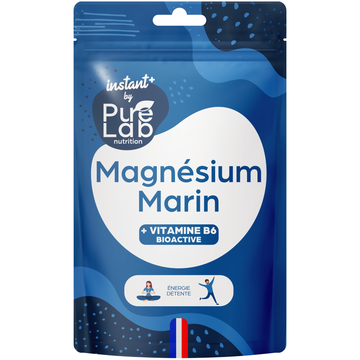
🌊 Instant+ Marine Magnesium
✅ 300 mg of marine magnesium per day, combined with vitamin B6
✅ Pocket format, 15-day course
✅ Vegetable capsules, lactose and gluten-free
👉 Discover our Instant+ Marine Magnesium here.
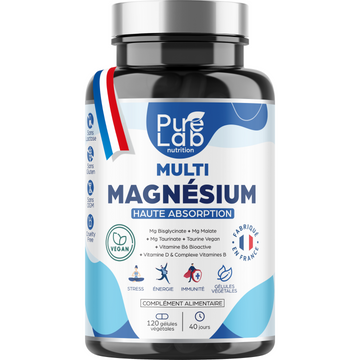
🧬 Multi Magnesium
✅ Three combined forms: bisglycinate, malate, and taurate, for 300 mg of magnesium per day
✅ With vitamins B6 and D
✅ Vegan formula, 40-day course
👉 Discover our Multi Magnesium here.
To go further, read our article Marine magnesium: advantages, limitations, and for whom? and our guide to choosing your magnesium.
Common mistakes
- Comparing the weight of the salt rather than the amount of elemental magnesium
- Taking two magnesium-based products at the same time without adding up the doses
- Changing form every three days: give a course the time to take effect
- Ignoring digestive disruption: if this happens, reduce the amount, spread out the doses, or change the form
Frequently asked questions
❓ Can you alternate between the two forms?
Yes. Many people use a pocket format when traveling and a longer-term formula at home. Just be careful not to take them on the same day without doing the total count.
❓ Does bisglycinate make you sleep?
No form of magnesium is a sleeping pill. Magnesium contributes to normal nervous system functioning and normal psychological functions, making it a natural ally for an evening routine.
❓ Which one acts the fastest?
No study confirms that one form acts faster than another. The consistency of intake counts much more.
❓ Are there any precautions?
In case of kidney disease, pregnancy, breastfeeding, or ongoing medical treatment, seek the advice of your doctor or pharmacist before starting any course.
In summary
1️⃣ Marine: natural, concentrated, practical for short courses
2️⃣ Bisglycinate: gentle on the gut, ideal for long courses
3️⃣ No universal "best form": everything depends on your profile
4️⃣ Consistency above all: the right magnesium is the one you take every day
Pure Lab Nutrition ... The art of nourishing your well-being.
Sources:
- Felice V.D., O'Gorman D.M., O'Brien N.M., Hyland N.P. (2018). Bioaccessibility and Bioavailability of a Marine-Derived Multimineral, Aquamin-Magnesium. Nutrients, 10(7), 912. PubMed
- Schuette S.A., Lashner B.A., Janghorbani M. (1994). Bioavailability of magnesium diglycinate vs magnesium oxide in patients with ileal resection. Journal of Parenteral and Enteral Nutrition, 18(5), 430-435. PubMed
- Pouteau E., Kabir-Ahmadi M., Noah L., Mazur A., Dye L., Hellhammer J., Pickering G., Dubray C. (2018). Superiority of magnesium and vitamin B6 over magnesium alone on severe stress in healthy adults with low magnesemia: A randomized, single-blind clinical trial. PLoS ONE, 13(12), e0208454. PLoS ONE
- ANSES (2021). Nutritional references for vitamins and minerals. anses.fr
- Regulation (EU) No 432/2012 establishing a list of permitted health claims. EUR-Lex


Restez informé 🌿
Recevez nos derniers articles et conseils santé directement dans votre boîte mail.