


















Flavored collagen: taste, quality, and effectiveness—is it really the same?
Plain, peach, lemon… collagen powder now comes in a variety of flavors. But is flavored collagen as high-quality as neutral collagen? Does the taste affect its efficacy? Let’s separate fact from fiction.
📑 Contents
- Why flavor collagen powder?
- Common misconceptions about flavored collagen
- Reading the label: quality criteria to check
- What about efficacy? What the studies say
- The role of Vitamin C: the benefit of lemon
- So, flavored or neutral: how to choose?
🤔 Why flavor collagen powder?
Hydrolyzed marine collagen is a protein-based raw material with a taste and smell that can sometimes be noticeable. The best formulas are deodorized, but some people still appreciate a more pleasant flavor, especially for daily consumption.
The argument is primarily practical: a drink you enjoy is easier to stick with, and consistency is the key to any routine. Flavoring is therefore a matter of convenience, not a guarantee of performance. That is why the real question isn't "flavored or not," but "what exactly is in the jar?"
🧾 What a flavored powder contains
Depending on the brand, the flavor may come from natural or artificial aromas, fruit powders, or dehydrated juices. Sometimes sweeteners, sugars, bulking agents, or colorings are added. The composition varies greatly from one product to another, and this is where the difference in quality comes into play.
🧠 Common misconceptions about flavored collagen
❌ "Flavored means less effective"
False, or at least not systematically. The flavoring itself does not alter the collagen peptides. What matters is the amount of collagen per serving, the type of peptides, and the duration of use. A properly dosed flavored powder can easily be equivalent to a neutral powder, while an under-dosed neutral powder will have no particular benefit.
❌ "Neutral is necessarily purer"
Not always. A neutral powder may contain anti-caking agents or excipients, while a flavored powder may have a very short ingredient list. Only by reading the label can you decide.
❌ "Good taste means lots of sugar"
This is not inevitable. Some formulas rely on natural flavors without added sugars. When in doubt, look for the carbohydrate content per serving and check for the presence of sweeteners in the ingredient list.
❌ "The sweeter it is, the better it dissolves"
Dissolution depends primarily on the degree of peptide hydrolysis and the quality of the powder. High-quality hydrolyzed collagen dissolves well in liquid, whether sweet or not, cold or lukewarm.
🔎 Reading the label: quality criteria to check
To compare two collagen products, whether flavored or not, here are the points to check.
- Collagen dose per serving: check the actual amount of peptides, not the total weight of the powder.
- The nature of the collagen: hydrolysate or peptides, marine, bovine or porcine origin, and the type(s) involved. To better understand these differences, see Marine vs. Bovine Collagen.
- The list of ingredients: the shorter and more readable it is, the simpler the formula.
- The nature of the flavor: natural flavor, fruit extract, or artificial flavor.
- Sugars and sweeteners: quantity per serving and type.
- Associated nutrients: Vitamin C, for example, has a documented interest in relation to collagen (see below).
Our guide How to read a food supplement label details the process, and What is the best collagen powder? offers a complete comparison.
🧪 What about efficacy? What the studies say
Let's be transparent: no health claims are currently authorized for collagen in the European Union. We therefore cannot present an official benefit. What we can say is that research is looking into it.
A randomized, placebo-controlled trial conducted on middle-aged women reported differences in measured skin parameters (hydration, elasticity, density) after several weeks of taking a specific collagen peptide (Bolke et al., 2019). A meta-analysis of randomized trials also observed, on average, favorable results for skin hydration and elasticity, while highlighting the uneven quality of studies and the significant weight of industry funding (de Miranda et al., 2021).
⚖️ Key takeaways
These studies focus on specific products, at specific doses, over specific durations. None have rigorously compared "neutral taste" and "flavored taste." Therefore, we cannot say that flavor alters efficacy, nor the reverse. The factor that counts is the dose of peptides actually ingested, day after day.
Furthermore, a pharmacokinetic study has shown that peptides resulting from the breakdown of collagen are found in the blood after ingestion of a hydrolysate (Iwai et al., 2005), which explains the interest in the hydrolyzed form, regardless of the flavor.
🍋 The role of Vitamin C: the benefit of lemon
This is probably the most solid point in nutrition. Vitamin C contributes to normal collagen formation for the normal function of the skin: this is a claim authorized by Regulation (EU) No. 432/2012. It acts as a cofactor for enzymes involved in collagen synthesis (Pullar et al., 2017).
This explains why citrus flavors, like lemon, are so popular with collagen: they evoke Vitamin C. However, be careful: lemon flavoring alone does not provide Vitamin C. Only added Vitamin C or fresh lemon juice actually provides it. One study even showed that taking gelatin enriched with Vitamin C before exercise increased markers of collagen synthesis (Shaw et al., 2017), but this is a specific experimental model.
🥤 The homemade trick
If your collagen does not contain Vitamin C, you can pair it with squeezed lemon juice or a fruit rich in Vitamin C. Our article Collagen and Vitamin C: why combine them? details this complementarity.
✅ So, flavored or neutral: how to choose?
Here is our simple and honest guide.
- You like the taste of plain collagen or you include it in recipes: a neutral powder is ideal.
- You want a pleasant drink daily: a mild flavor can help with consistency, provided you check the label.
- You are sensitive to sugar: prioritize formulas with no added sugar and read the ingredient list.
- You are traveling: capsules or sachets may be more practical. Our article Collagen in tablets, capsules or powder helps you choose the format.
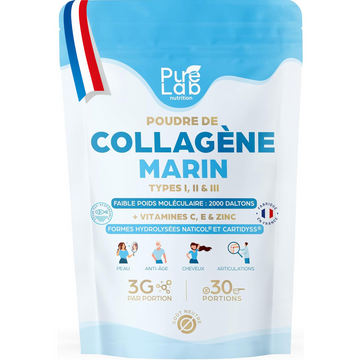
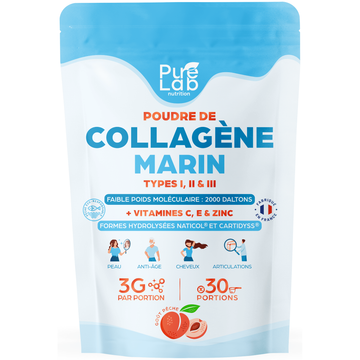
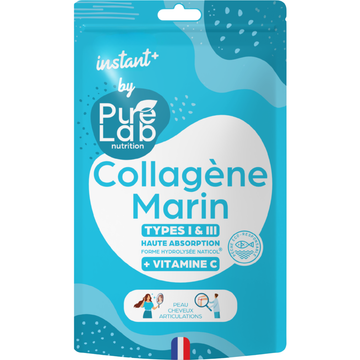
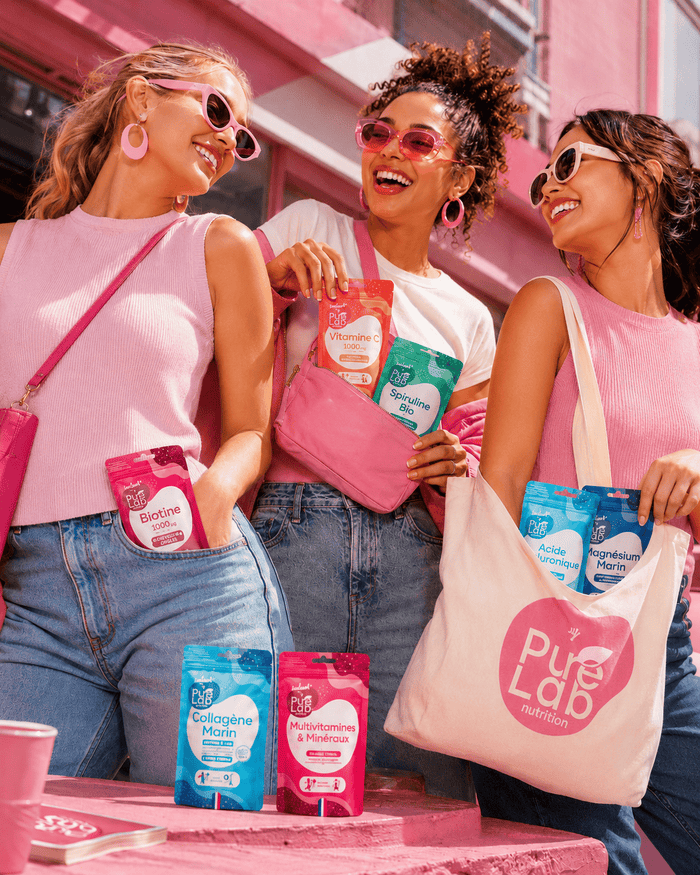
At Pure Lab Nutrition, we offer marine collagen powder available in neutral or peach flavor, with Vitamins C and E as well as zinc. Vitamin C contributes to normal collagen formation for the normal function of the skin, and zinc contributes to the maintenance of normal skin. For a pocket-friendly format, also discover our Instant+ Marine Collagen, or our peach-flavored marine collagen powder.
✅ Our marine collagen powder at Pure Lab Nutrition: a powder formula combining hydrolyzed marine collagen (3 g per day), Vitamins C and E, and zinc bisglycinate, available in neutral or peach flavor.
👉 Discover our Marine Collagen Powder here.
✅ In summary
1️⃣ Flavoring is a matter of convenience: it does not in itself improve or reduce the efficacy of collagen.
2️⃣ Quality is judged by the dose of peptides per serving, the list of ingredients, and the nature of the flavor.
3️⃣ There are no health claims for collagen in Europe, but Vitamin C contributes to normal collagen formation for the normal function of the skin.
4️⃣ The right collagen is the one you take regularly, whose label is clear and whose taste suits you.
Pure Lab Nutrition — The art of nourishing your well-being.
Scientific sources:
- Bolke L, Schlippe G, Gerß J, Voss W. A Collagen Supplement Improves Skin Hydration, Elasticity, Roughness, and Density: Results of a Randomized, Placebo-Controlled, Blind Study. Nutrients. 2019;11(10):2494.
- de Miranda RB, Weimer P, Rossi RC. Effects of hydrolyzed collagen supplementation on skin aging: a systematic review and meta-analysis. International Journal of Dermatology. 2021;60(12):1449-1461.
- Iwai K, Hasegawa T, Taguchi Y, et al. Identification of food-derived collagen peptides in human blood after oral ingestion of gelatin hydrolysates. Journal of Agricultural and Food Chemistry. 2005;53(16):6531-6536.
- Pullar JM, Carr AC, Vissers MCM. The Roles of Vitamin C in Skin Health. Nutrients. 2017;9(8):866.
- Shaw G, Lee-Barthel A, Ross ML, Wang B, Baar K. Vitamin C-enriched gelatin supplementation before intermittent activity augments collagen synthesis. American Journal of Clinical Nutrition. 2017;105(1):136-143.


Restez informé 🌿
Recevez nos derniers articles et conseils santé directement dans votre boîte mail.