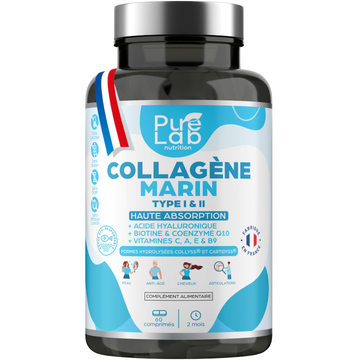
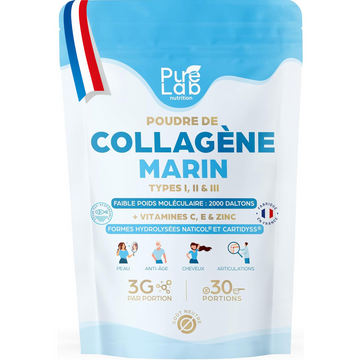
























What is the best collagen powder? Comparison & advice
Facing the multitude of collagen powders on the market, how can you distinguish the exceptional from the conventional? This comprehensive guide deciphers the essential criteria for selecting the best collagen powder, with a detailed comparison of the available options.
At Pure Lab Nutrition, we believe in total transparency. Our goal is to provide you with all the keys to making an informed choice, whether it concerns our products or those of other brands.
Summary
- What is collagen powder and what is it used for?
- The different types of collagen: which one to choose?
- Essential criteria for choosing the best collagen powder
- Comparison of the best collagen powders
- Pure Lab Nutrition collagen: our approach
- Frequently asked questions
What is collagen powder and what is it used for?
Collagen is the most abundant protein in the human body, accounting for approximately 30% of all proteins. It forms the structural framework of our organism: skin, bones, tendons, ligaments, cartilage, and blood vessels all depend on it.
Natural collagen production begins to decline from the age of 25, at a rate of about 1% per year. By age 40, this decrease accelerates, causing visible signs: wrinkles, loss of skin elasticity, joint pain, and bone fragility.
Why opt for powder rather than other forms?
The powder form has several decisive advantages:
- High dosage: Clinical studies recommend 5 to 15g per day, doses that are difficult to achieve with capsules
- Flexibility: Easy to incorporate into drinks, smoothies, yogurts
- Value for money: Generally more economical per gram of collagen
- Absorption: Optimal bioavailability when dissolved in a liquid
The different types of collagen: which one to choose?
There are 28 identified types of collagen, but three dominate the dietary supplement market:
Type I Collagen
The most abundant (90% of body collagen), present in the skin, bones, tendons, and ligaments. It is the ideal type for:
- Skin health and elasticity
- Bone strength
- Strength of tendons and ligaments
Type II Collagen
Specifically present in cartilage. Recommended for:
- Joint health
- Prevention of osteoarthritis
- Mobility in athletes
Type III Collagen
Often associated with type I, present in the skin, organs, and blood vessels. Contributes to:
- Skin elasticity
- Cardiovascular health
- Tissue regeneration
Essential criteria for choosing the best collagen powder
1. Origin and source
Marine: Extracted from fish skin and scales. Studies show 1.5 times greater bioavailability compared to bovine collagen. Ideal for skin, hair, and nails.
Bovine: Derived from bovine bones and cartilage. Rich in types I and III. Good choice for skin and muscles, slightly less bioavailable than marine.
Chicken: Naturally rich in type II. Specifically recommended for joint health.
2. Hydrolysis: a key step
Hydrolysis breaks down collagen molecules into smaller peptides (hydrolyzed collagen or collagen peptides), drastically improving their intestinal absorption. Non-hydrolyzed collagen is much less effective.
What is molecular weight?
The smaller the peptides (low molecular weight in Daltons), the easier they cross the intestinal barrier. The best hydrolyzed collagens have peptides of 1,000 to 5,000 Daltons.
3. Purity and composition
Quality collagen must:
- Contain at least 90-95% protein
- Have an amino acid profile rich in glycine, proline, and hydroxyproline
- Exclude unnecessary additives (artificial flavors, added sugars, GMOs)
4. Certifications and traceability
Prioritize brands that display:
- ISO or GMP (Good Manufacturing Practices) certifications
- Independent laboratory analyses
- Full traceability of sources
5. The effective dosage
Clinical studies demonstrate efficacy at doses of:
- 2.5 to 5g/day for skin
- 5 to 10g/day for joints
- 10 to 15g/day for athletes
Comparison of the best collagen powders
Note: Our comparison is based on objective criteria. We analyze available products without bias, including our own formulas, which we subject to the same requirements.
Rating criteria (out of 5)
- Source and origin
- Degree of hydrolysis
- Protein content
- Absence of additives
- Certifications
- Value for money
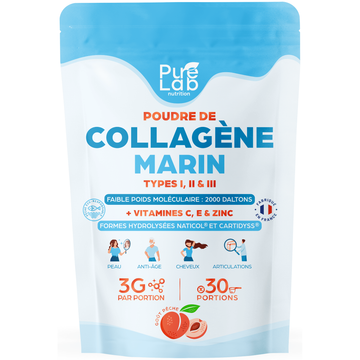
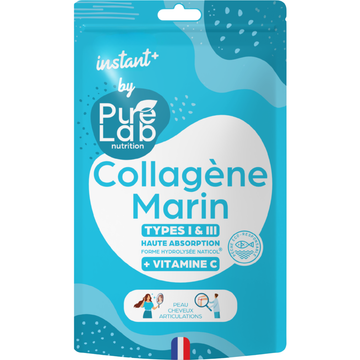
Pure Lab Nutrition – Premium Marine Collagen
Overall score: 4.8/5
Strengths:
- Type I and III hydrolyzed marine collagen (95% protein)
- Low molecular weight peptides (2,000 Da)
- Enriched with vitamin C (essential cofactor)
- Zero additives, zero added sugar
- Neutral taste, dissolves perfectly
Area for improvement:
- Premium price (justified by quality)
Brand B – Standard Bovine Collagen
Overall score: 3.2/5
Strengths:
- Affordable price
- Wide availability
Weaknesses:
- High molecular weight (poor absorption)
- Contains additives (maltodextrin, flavorings)
- Opaque traceability
Brand C – Economical Marine Collagen
Overall score: 3.5/5
Strengths:
- Certified marine source
- Competitive price
Weaknesses:
- Partial hydrolysis
- Lower protein content (78%)
Brand D – Multi-source Collagen
Overall score: 3.8/5
Strengths:
- Blend of types I, II, and III
- Holistic approach
Weaknesses:
- Total dosage often insufficient
- Incomplete certifications
Pure Lab Nutrition Collagen: Our approach
Our philosophy is based on three pillars:
Absolute transparency
We fully disclose our sources, manufacturing processes, and certifications. Each batch is analyzed by an independent laboratory.
Scientific excellence
Our formulas are developed in collaboration with nutritionists and based on the latest published scientific research. We exclusively use ingredients with proven efficacy.
Ethical commitment
Our marine collagens come exclusively from certified sustainable fisheries. Environmental responsibility guides every decision we make.
Our full range
Premium Marine Collagen: Our flagship formula for skin, hair, and nails. 10g of marine peptides per serving, enriched with bioactive vitamin C.
Joints+ Collagen: A specific formula combining types I, II, and III with glucosamine and chondroitin for optimal support for cartilage.
Sport Performance Collagen: Specially formulated for athletes, with 15g of collagen, BCAAs, and glycine.
Discover our full range at purelabnutrition.com
Frequently Asked Questions
What is the best time to take collagen powder?
Morning on an empty stomach optimizes absorption. However, consistency is more important than timing: the key is to take it daily. With a bit of vitamin C (lemon juice, ascorbic acid), you maximize collagen synthesis.
How long before I see results?
Clinical studies observe significant improvements after 4 to 8 weeks of regular consumption. For joints, it may take 3 to 6 months for the full effects to manifest.
Can you take too much collagen?
Hydrolyzed collagen is generally well-tolerated even at high doses (30g/day in some studies). Digestive issues may occur at very high doses. Stick to the manufacturer's recommendations.
Plant-based collagen: real or myth?
There is no such thing as plant-based collagen (collagen is an animal protein). Some "vegan" products contain precursors (amino acids, vitamin C) that stimulate endogenous synthesis. Less direct, but interesting for vegans.
Can collagen replace sports proteins?
No, collagen has an incomplete amino acid profile (low in BCAAs). It ideally complements standard protein intake (whey, plant-based proteins) by specifically targeting connective tissues.
Pure Lab Nutrition ... The art of nourishing your well-being.


Restez informé 🌿
Recevez nos derniers articles et conseils santé directement dans votre boîte mail.