




























How does magnesium affect our sleep?
Nearly 73% of French people suffer from sleep disorders according to INSV, turning their nights into real obstacle courses. Yet, the solution could lie in a discreet yet powerful mineral: magnesium, a true conductor of our sleep architecture.
At Pure Lab Nutrition, we have guided thousands of clients towards restorative sleep thanks to our in-depth understanding of the neurobiological mechanisms of rest. Because behind every peaceful night lies a complex biochemical symphony where magnesium plays the leading role.
Discover how this "deep sleep mineral" transforms your nocturnal cycles and why our premium French approach is revolutionizing the quality of your nights.
Table of Contents
- Sleep Architecture: Neurobiological Foundations
- Magnesium: Master Regulator of Circadian Rhythms
- Hormonal Synergy: Melatonin and Neurotransmitters
- Therapeutic Protocols for Optimal Sleep
- Pure Lab Nutrition and the Science of Restorative Sleep
Sleep Architecture: Neurobiological Foundations
🧠 Decoding Sleep Phases
Our sleep is structured around 90-120 minute cycles orchestrated by sophisticated neurochemical mechanisms:
Phase N1-N2: Light Sleep (25% of total time)
- Progressive decrease in cortical activity: Wake-sleep transition
- Reduction in body temperature: Signal for falling asleep
- Slowing of heart rate: Transition to recovery mode
- Progressive muscle relaxation: Preparation for deep sleep
Phase N3: Deep Sleep (20-25% of total time)
- Dominant delta waves (0.5-4 Hz): Maximum neuronal synchronization
- Secretion of growth hormone: Tissue regeneration
- Consolidation of declarative memory: Integration of learning
- Cerebral detoxification: Elimination of metabolic waste
REM Phase: Paradoxical Sleep (20-25% of total time)
- Intense brain activity: Emotional processing
- Vivid and structured dreams: Psychological integration
- Temporary muscle paralysis: Protection during dreams
- Suspended thermal regulation: Priority for dream processes
⚡ Modern Neurochemical Imbalances
Our contemporary lifestyle disrupts this delicate orchestration:
Blue light exposure: Melatonin suppression (-42% on average)
Chronic stress: Elevated nocturnal cortisol (+65% in insomniacs)
Industrial diet: Cofactor enzymatic deficiencies
Disrupted rhythm: Desynchronization of the circadian clock
Magnesium: Master Regulator of Circadian Rhythms
🔬 Neurobiological Mechanisms of Action
Magnesium exerts a multidimensional influence on sleep architecture:
Modulation of Excitation/Inhibition Balance
MAGNESIUM → ⬆️GABA-A Receptors → ⬆️Neuronal Inhibition → ⬆️Relaxation
          ↓
          → ⬇️NMDA Receptors (glutamate) → ⬆️Excitation → ⬇️Hypervigilance
GABAergic action: Magnesium acts as a positive allosteric modulator of GABA-A receptors, amplifying the natural sedative effect of this primary inhibitory neurotransmitter.
Glutamatergic antagonism: It partially blocks voltage-dependent calcium channels, reducing excessive glutamate release responsible for neuronal hyperexcitability.
Regulation of the Circadian Clock
Magnesium directly influences the suprachiasmatic nucleus (our internal biological clock):
Stabilization of cellular oscillators: Regulation of CLOCK and BMAL1 genes Light sensitivity: Modulation of retinal response to light signals Synchronization of peripheral rhythms: Coordination of tissue clocks Synaptic plasticity: Facilitation of adaptation to time changes
🌙 Impact on Deep Sleep Quality
Polysomnographic studies reveal that magnesium supplementation:
- Increases deep sleep duration by +18% on average
- Reduces sleep onset latency by 35% in insomniacs
- Decreases nocturnal awakenings by -27%
-
Improves sleep efficiency (time asleep/time in bed) by +15%
Hormonal Synergy: Melatonin and Neurotransmitters
🌒 Optimized Melatonin Cascade
Magnesium potentiates endogenous melatonin production via several mechanisms:
Pineal Gland Protection
- Decalcification of the epiphysis: Prevention of fluoride accumulation
- Preservation of enzymatic activity: Maintenance of N-acetyltransferase
- Antioxidant protection: Reduction of nocturnal oxidative stress
- Optimal vascularization: Improvement of glandular perfusion
Optimization of the Biosynthetic Cascade
Tryptophan → 5-HTP → Serotonin → N-Acetylserotonin → MELATONIN
     ↑           ↑         ↑              ↑              ↑
   Mg++        B6-P5P    Mg++           Mg++          Mg++
Serotoninergic Optimization
Magnesium cofactors tryptophan hydroxylase, the rate-limiting enzyme for serotoninergic synthesis:
- ↑ Serotonin production: +23% observed in clinical studies
- ↑ 5-HT1A receptors: Improvement of anti-anxiety signaling
- ↑ Tryptophan transport: Facilitated passage across the blood-brain barrier
Dopaminergic Modulation
- Regulation of D2 receptors: Balance of excitation/reward
- Reduction of restlessness: Decrease in nocturnal mental hyperactivity
-
Mood stabilization: Positive impact on dreams and REM sleep
Therapeutic Protocols for Optimal Sleep
💊 Therapeutic Timing and Dosage
The chronobiology of magnesium reveals optimal efficacy windows:
Standard Protocol (Mild Disorders)
Dosage: 300-400 mg elemental magnesium
Timing: 2 hours before desired bedtime
Duration: Minimum 8 weeks for cycle restructuring
Optimal form: Bisglycinate (maximized nocturnal absorption)
Intensive Protocol (Chronic Insomnia)
> Loading Phase (4 weeks):
- 200 mg at dinner + 300 mg 1 hour before bedtime
- Combination of vitamin B6 (20 mg) + taurine (500 mg)
> Consolidation Phase (8 weeks):
- 400 mg 90 minutes before bedtime
- Monitoring of efficacy with a sleep journal
🍽️ Complementary Nutritional Strategies
Sleep-Enhancing Foods
Nocturnal magnesium sources: Prioritize in the evening
- Pumpkin seeds 🎃: 592 mg/100g + synergistic zinc
- Raw cocoa 🍫: 499 mg/100g + relaxing theobromine
- Cooked spinach 🥬: 157 mg/100g + neuroprotective folates
Optimal Nutritional Timing
3 hours before bedtime: Last substantial meal (avoid nocturnal digestion)
2 hours before bedtime: Magnesium-rich herbal tea or supplement
1 hour before bedtime: Stop screens and prepare for sleep
30 minutes before bedtime: Relaxation ritual (reading, meditation)
🚫 Sleep Antagonists to Avoid
Residual caffeine: Half-life of 6 hours, stop after 2 PM
Disruptive alcohol: REM sleep fragmentation
Late meals: Stimulating digestive thermogenesis
Intense exercise: Avoid 4 hours before bedtime (stimulating effect)
Pure Lab Nutrition and the Science of Restorative Sleep
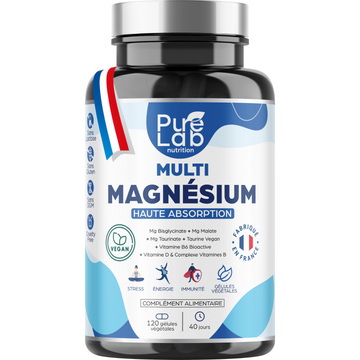
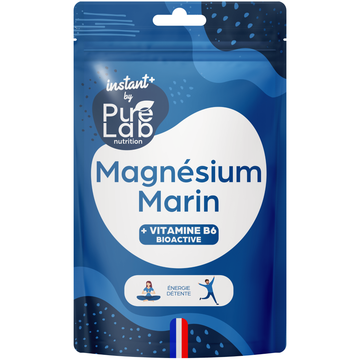
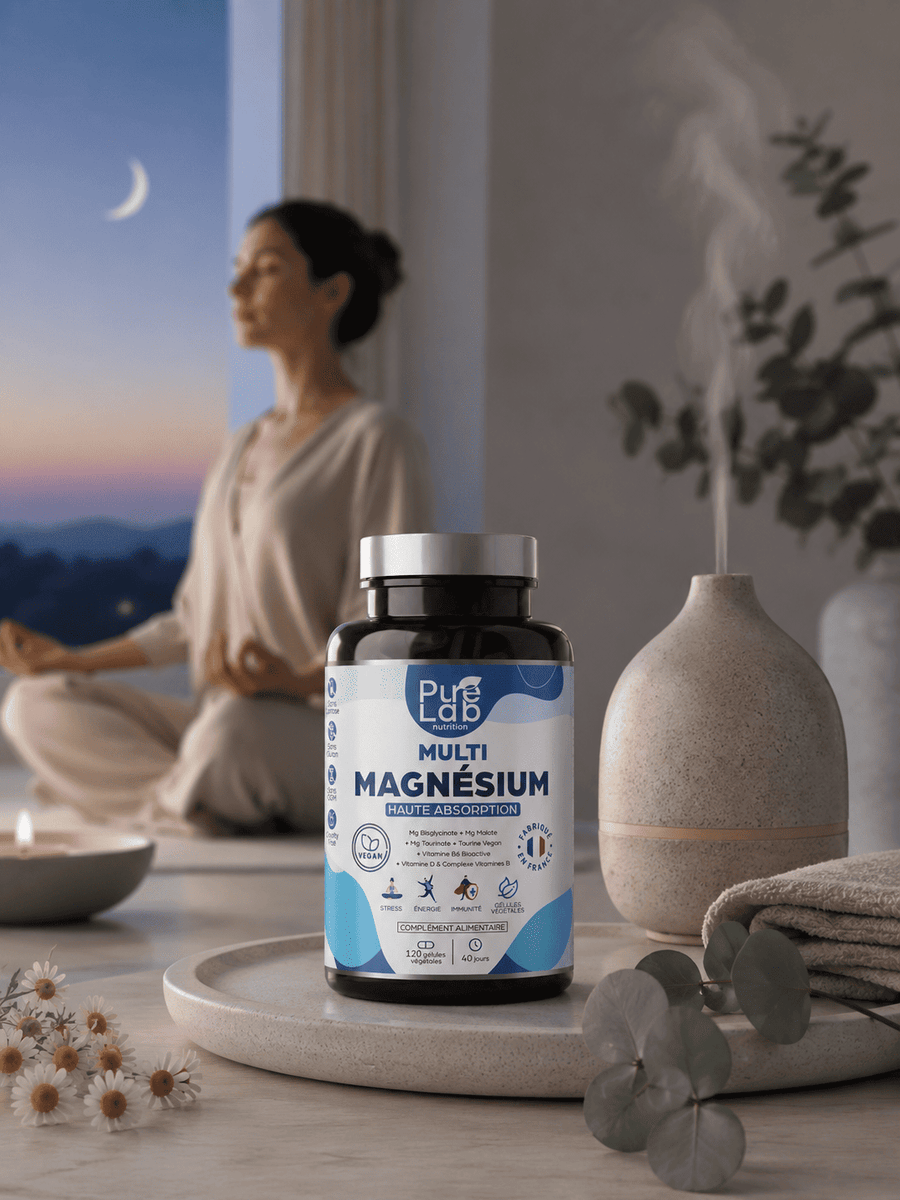
🇫🇷 Multi Magnesium
Our French expertise has developed an optimized nocturnal synergy:
🌙 Magnesium Bisglycinate
- Extended release: Action over 6-8 hours
- Optimal crossing: Facilitated passage through cell membranes
- Perfect tolerance: Zero nocturnal digestive issues
⚡ Magnesium Taurate
- Cardiac modulation: Regulation of nocturnal rhythm
- Neuroprotection: Stabilization of neuronal membranes
- Anxiolytic effect: Reduction of rumination
🔋 Magnesium Malate
- Energy recovery: Optimization of mitochondria
- Nocturnal detoxification: Hepatic support during sleep
- Muscle regeneration: Optimized anabolic phase
+ Specialized Synergistic Cofactors
Vitamin B6 P-5-P: Active coenzymated form
- Tryptophan→serotonin conversion: +67% efficiency vs pyridoxine
- Optimized GABA synthesis: Potentiation of relaxing effect
- Homocysteine reduction: Nocturnal cardiovascular protection
Taurine (vegan): Inhibitory neurotransmitter
- Calcium modulation: Regulation of muscle contractions
- GABA-mimetic effect: Amplification of relaxation
- Retinal protection: Optimization of circadian sensitivity
Vitamin D3: Regulatory hormone
- Cerebral VDR receptors: Modulation of nocturnal mood
- Magnesium absorption: Assimilation synergy
- Seasonal rhythms: Compensation for light variations
🏆 Sleep Protocol
Induction Program (First 2 weeks)
Dosage: 3 capsules 90 minutes before bedtime
Ritual: With warm chamomile tea (not hot)
Environment: Temperature 18-19°C, total darkness
Monitoring: Daily sleep journal
Consolidation Program (Weeks 3-12)
Dosage: 2 capsules 1 hour before bedtime
Maintenance: Regular bedtime ±30 minutes
Optimization: Adjustment according to personal effectiveness
Evaluation: Polysomnographic control at 3 months
Summary: Your Passport to Restorative Nights
Magnesium revolutionizes the approach to sleep by acting on the fundamental mechanisms of your nocturnal rest. Our premium French expertise offers you:
🎯 Proven neurobiological modulation: GABA, melatonin, serotonin
🎯 Chronobiological formulation: Tri-magnesium with optimized release
🎯 Synergistic cofactors: B6-P5P, taurine, vitamin D3
🎯 Personalized protocol: Adaptation to your sleep profile
🎯 Pharmaceutical quality: Systematic laboratory controls
🎯 Holistic approach: Sustainable cycle restructuring
Your nights deserve scientific excellence. Transform your sleep with our Multi Magnesium and rediscover the pleasure of truly restorative nights.
Pure Lab Nutrition... The art of nourishing your well-being.
Scientific sources:
- Sleep Medicine Reviews - "Magnesium and sleep quality" (2017)
- Journal of Sleep Research - "Magnesium supplementation and sleep" (2012)
- Chronobiology International - "Circadian rhythms and magnesium" (2019)
- European Journal of Clinical Nutrition - "Magnesium and melatonin interaction" (2011)


Restez informé 🌿
Recevez nos derniers articles et conseils santé directement dans votre boîte mail.


